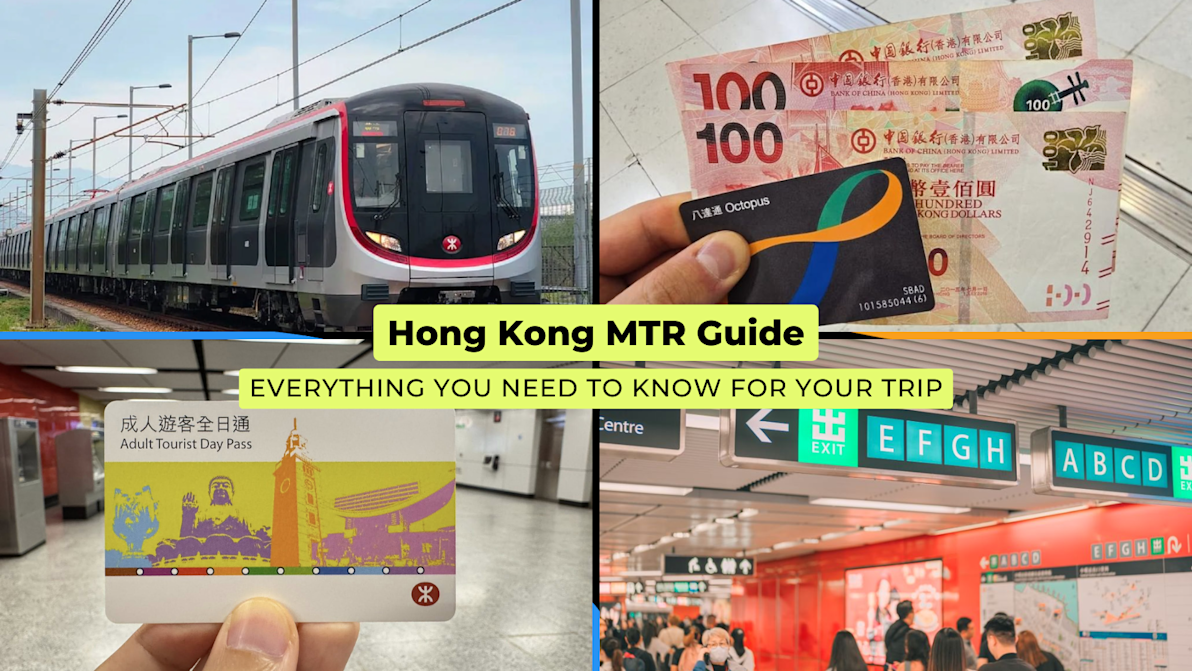
Getting around Hong Kong is a breeze once you know your way around the MTR. This metro system is fast, affordable and seriously efficient.
Whether you’re heading to the Big Buddha, catching fireworks over Victoria Harbour, exploring shopping centres and commercial developments, or just looking to avoid a taxi queue, the MTR is your best bet.
In this guide, we’ll cover everything you need to know about riding the Hong Kong MTR, from how to get an Octopus Card to which station exit leads straight to the famous Ladies' Market in Mong Kok. Let’s get moving!
1. What Is the Hong Kong MTR and Why Do Tourists Use It?
The Hong Kong MTR (Mass Transit Railway) is a fast, reliable transit system with over 160 stations connecting major attractions, shopping areas and districts across the city.
It covers Hong Kong Island, Kowloon, the New Territories and even links to the airport and the border with Shenzhen.
Trains are clean, safe and run like clockwork, making the MTR the easiest way for tourists to get around. Each train line is color-coded, and clear signage helps passengers transfer to a new line or other lines at interchange stations. Whether you’re heading to Disneyland or dashing across the harbour to Tsim Sha Tsui, it’s the no-brainer choice.
2. How Do You Use the Hong Kong MTR for the First Time?
To use the MTR, tap in at the gate with an Octopus Card, contactless credit card, or ticket. The MTR logo is prominently displayed at station entrances and fare gates, making it easy to locate the MTR and access ticketing areas.
Follow the colour-coded signs to your platform - major interchange stations are clearly marked for easy transfers between lines - and when you arrive, tap out at your destination. English signs and station maps are everywhere, and bilingual information on signage and announcements simplifies navigation for non-Cantonese speakers. If you make a mistake, staff at Customer Service Centres can assist.
3. What Are the Rules and Etiquette on the Hong Kong MTR?
Here are some things to keep in mind when hopping on an MTR train:
No eating or drinking is allowed.
Always queue behind platform lines.
Let passengers exit before entering.
Keep bags close; you don't want to lose sight of your belongings.
Offer priority seats to those in need.
Stand on the right of escalators and avoid blocking exits.
Let passengers exit the train before boarding to maintain proper etiquette.
Think of it as commuting with Jedi discipline: respect the space, flow and order.
4. How Much Does Riding the Hong Kong MTR Cost?
Fares depend on distance. Short rides cost around USD 0.50-0.75, longer cross-city trips can be USD 2.50-3.50. Using an Octopus Card offers a slight discount compared to single tickets. Children and seniors get reduced fares.
Single journey tickets are available for one-time trips and can be purchased from vending machines at all MTR stations.
Route | Octopus Fare |
|---|---|
Central to Tsim Sha Tsui | USD 1.40 |
Mong Kok to Admiralty | USD 1.55 |
Tsim Sha Tsui to Sham Shui Po | USD 0.95 |
Hong Kong to Lo Wu (Shenzhen) | USD 5.35 |
5. How Can You Check MTR Fares Before You Travel?
You can check fares using the official MTR Mobile app (available on both iOS and Android) or the MTR Corporation website.
n the app, tap the "Trip Planner" icon on the home screen, then enter your starting point and destination. It will show your fare, journey time, platform details and transfer stations, if any.
If you prefer a desktop, head to the official website. Click on "Trip Planner" at the top menu, enter your route and you'll see detailed fare and journey info instantly. Fare charts are also posted inside stations, near ticket machines.
Google Maps and Citymapper also integrate MTR fare data. Handy if you're plotting routes while sipping bubble tea.
6. What Is the Hong Kong MTR Tourist Pass?
It refers to the Tourist Day Pass or the Airport Express Travel Pass, which bundles one or two Airport Express rides plus 72 hours of unlimited MTR use. Perfect for short stays, whether you're a city explorer or theme park devotee.
7. Is the Hong Kong MTR Day Pass or Tourist Pass Worth It?
Photo: Sunny Day Station on Facebook
Yes, if you plan to make multiple rides in one day. The Hong Kong MTR Tourist Day Pass (USD 9.60) offers unlimited rides (excluding Airport Express and cross-border). If your daily travel would exceed that amount, it saves you money and time and gives you Marvel-like teleportation powers around the city.
8. Is an Unlimited MTR Pass Worth it?
Photo: @hkreminiscence on Instagram
It depends on usage. If you’re visiting 3 or more areas a day (like Hong Kong Disneyland, Central and Mong Kok), it pays off.
Light travellers might save more with pay-per-ride via Octopus. But if you're doing a full-on Emily-in-Asia itinerary, go unlimited.
9. Should Tourists Buy an Octopus Card?
Photo: @sailaway.lounge.hk on Instagram
Absolutely. It’s the most convenient way to pay for transport and works across trains, buses, ferries and even shops. You can also use it at fast food restaurants for convenient dining. It avoids queues, gives fare discounts and allows negative balance up to USD -4.50, meaning you can exit the gate even with insufficient balance and top up later.
10. How Much Does the Octopus Card Cost?
Photo: @qipology on Instagram
A standard adult card costs USD 19.20, with USD 12.80 stored value and a USD 6.40 refundable deposit.
A Tourist Octopus (USD 5) has no deposit and is non-refundable after 3 months. A fee of USD 1.40 applies if refunded within 90 days.
11. Where Can You Buy an Octopus Card in Hong Kong?
Photo: @npiqueglobal on Instagram
Get one at the airport, any MTR station Customer Service Centre, or convenience stores like 7-Eleven (for tourist version). They’re also available online for airport pickup. Don’t forget to top up if you buy the tourist version, as it comes with no stored value. The Tourist Octopus Card costs approximately USD 14 and is pre-loaded with HKD 50 (USD 6).
You can also pre-purchase the Octopus Card on Pelago, which is pre-loaded with HKD 50. You can pick it up at the airport once you arrive, making it perfect for seamless travel without any hassle.
12. How Do You Top Up or Refund an Octopus Card?
Photo: @naoki_daily.and.travel on Instagram
Top up at MTR machines, convenience stores or via the Octopus app. Refunds are processed at Customer Service Centres. If the card is returned within 90 days, USD 1.40 is deducted. Full refunds are given after 90 days.
13. Can You Pay for the Hong Kong MTR with a Credit Card?
Yes, most gates now accept contactless credit cards and mobile wallets. You get the same fare as an adult Octopus, but no child or senior discounts. Charges post at the end of the day as a grouped transaction. This is a great backup for short stays.
14. What Are Hong Kong MTR Operating Hours?
Most MTR trains run every 2-6 minutes from 6m until 1am, ensuring minimal wait times. However, during peak hours, you might be waiting up to 6-8 minutes. Always check for early closures during holidays or festivals.
15. When Are MTR Rush Hours and How Crowded Does It Get?
Peak hours are 9am–10am and 6pm–7pm on weekdays. Central, Mong Kok and Admiralty are especially crowded.
Avoid carrying large luggage during those times unless you want to cosplay as a salmon swimming upstream.
16. How Do You Get From Hong Kong Airport to the City by MTR?
Take the Airport Express. It reaches Central in 24 minutes. Fares start at USD 14.70. Trains run every 10 minutes. Free shuttle buses from Kowloon and Hong Kong stations connect to major hotels.
Groups of 2 or more can purchase discounted tickets (e.g. USD 21.80 total for 2 adults). You can also pre-purchase tickets on Pelago and scan a QR code to board. This is the best choice if you are trying to earn more KrisFlyer miles for your next vacation or don't want to buy tickets in-person.
17. Which Is the Best MTR Station for Tourists?
Popular stations include:
Tsim Sha Tsui: Harbour views, shopping, Avenue of Stars
Central: Peak Tram, ferries, business district, government offices
Admiralty: Transfer hub, Hong Kong Park, Ocean Park link
Mong Kok / Prince Edward: Markets, shopping streets
Disneyland Resort Station: Direct access to Hong Kong Disneyland
Many attractions are just a short walk from the station exits, and in some cases, it's only a short walk to reach key destinations.
Also note: Central to Hong Kong Station and East Tsim Sha Tsui to Tsim Sha Tsui are connected by walkways, which are often faster than train transfers.
18. Which MTR Exit Should You Use for Popular Attractions?
Use these for fast access:
Ladies Market: Mong Kok Exit E2
Temple Street Market: Jordan Exit A
Avenue of Stars: East Tsim Sha Tsui Exit J
Star Ferry: Tsim Sha Tsui Exit L6
Lan Kwai Fong: Central Exit D2
Man Mo Temple: Sheung Wan Exit A2
Big Buddha: Tung Chung Exit B + Ngong Ping 360
Ocean Park: Ocean Park Station (only one exit)
Victoria Peak Tram: Central Exit J2, or bus 15 from Admiralty
19. Can You Visit Victoria Peak, Hong Kong Disneyland, Big Buddha, or Ocean Park by MTR?
Yes, you can! Here’s how to get to these popular tourist spots:
Victoria Peak: Central Station, then walk to tram or take bus from Admiralty
Disneyland: Take the Tung Chung Line and transfer at Sunny Bay Station to the Disneyland Resort Line train. This specially themed train takes you directly to the park, featuring Disney character decor for a magical start to your visit.
Big Buddha: Tung Chung Station to Ngong Ping 360 cable car
Ocean Park: South Island Line to Ocean Park Station
20. How Do You Travel from Hong Kong to Shenzhen via the MTR?
Take the MTR East Rail Line to one of the two stations for border crossing: Lo Wu or Lok Ma Chau. After passing Hong Kong immigration, cross the border on foot, complete Chinese immigration, then board the Shenzhen Metro. Octopus is valid up to the Hong Kong border. You’ll need a visa if required by your nationality.
21. What Are the Most Common MTR Lines Tourists Use?
Tsuen Wan Line (Red): Central, Tsim Sha Tsui, Mong Kok
Island Line (Blue): Central, Admiralty, Causeway Bay
Tung Chung Line (Orange): Disneyland and Big Buddha access
Airport Express: Airport to Central/Kowloon
East Rail Line: For Shenzhen border
South Island Line: To Ocean Park
Tuen Ma Line / Kwun Tong Line: For local culture spots and interchanges
There are also other lines on the MTR network that connect different districts and attractions across Hong Kong, providing more options for reaching various destinations. The Shan line is another important route travelers should be familiar with for easier navigation and travel planning.
22. Where Can You Find a Hong Kong MTR Map?
Maps are posted in every station and train. You can also download them via the MTR app or website. Free paper maps are available at major stations and the airport. Search online for tourist versions with nearby attractions.
23. Is the Hong Kong MTR Safe and Tourist-Friendly?
Photo: @hongkong_guide on Instagram
Yes. It’s safe, clean, well-lit and monitored. Stations have lifts, accessible exits and baby-care rooms. Staff are helpful, announcements are in English and Chinese. It's built for smooth travel, even with luggage or a stroller.
24. What Should You Do If You Go to the Wrong Station or Don’t Have Enough Balance?
Photo: @pixelspictures25 on Instagram
Use Fare Adjustment machines or visit the Service Centre. Octopus cards allow a negative balance of up to USD -4.50, so you can exit and top up after.
If you took the wrong train, the staff can nullify the entry. You won't be penalised for small mistakes.
25. How Do You Transfer Between MTR Lines at Interchange Stations?
Transferring between MTR lines is simple thanks to clear signage and well-designed stations. Key interchange hubs include Central, Admiralty, Tsim Sha Tsui and Mong Kok.
For example, going from Tsim Sha Tsui to North Point? Just change at Central and follow the signs; no need to tap your Octopus card again. The fare is calculated when you exit at your final stop.
Signage is in English and Chinese, making navigation stress-free even for first-timers.
26. What Accessibility and Luggage Facilities Does the MTR Offer?
All MTR stations are equipped with lifts and ramps, making them accessible for wheelchair users, strollers and travellers with mobility needs. Trains have clearly marked priority seats for elderly, disabled and pregnant passengers.
Luggage is allowed on board, though it’s best to avoid peak hours. Major stations like Hong Kong International Airport and Central offer luggage storage. You’ll also find accessible toilets and baby care rooms in most stations, making the system easy and family-friendly.
27. How Do You Get Help While Using the Hong Kong MTR?
Each MTR station has a Customer Service Centre where staff can assist with ticket issues, directions or lost items. You can also call the customer service hotline for quick support.
The MTR Mobile app and official website provide real-time updates on schedules, fares and service alerts. Planning trips to places like Shenzhen? The Tourist Cross-boundary Travel Pass and Tourist Day Pass are available options.
With tools like the Octopus card and English signage, getting help on the MTR is quick and convenient.
28. What Are the Best Tips for Using the Hong Kong MTR Efficiently?
Travel off-peak (e.g. 9am-10am or after 8pm) to avoid crowds
Use an Octopus Card for faster, cheaper rides
Follow colour-coded line signs
Keep right on escalators
Have your card or device ready at gates
Use Google Maps or the MTR app for directions and exit info
Look for connected walkways between stations for faster interchanges
Use free Wi-Fi at major stations
Be at a station by 12mn to catch the last train
Enjoy the air-con, clean design and smooth experience
With the MTR, Hong Kong is your playground. Tap, ride, explore, repeat.