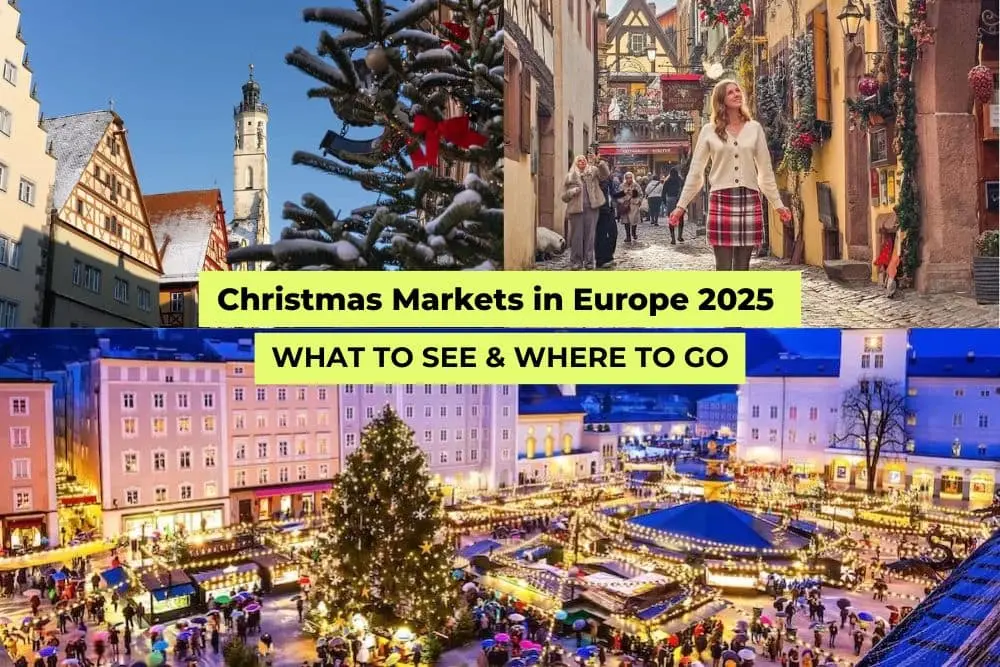
During the last months of the year, Europe transforms into a winter wonderland with twinkling lights, cosy wooden chalets, and the aroma of spiced treats.
Across the continent, Christmas markets fill historic squares with festive magic. You can spend days exploring all the merry markets, each offering its own unique charm. These markets date back centuries and have become a cherished tradition from the Alps to the Arctic Circle.
Whether you’re dreaming of German Weihnachtsmärkte laden with gingerbread and nutcrackers, or romantic French village markets glowing with lights, there’s something for everyone. Here are some of the best Christmas markets in Europe, as well as practical tips to make your trip a breeze.
Overview
Biggest: Strasbourg Christmas Market (France)
Most Romantic: Colmar & Riquewihr (France)
Best for Families: Jul i Vinterland (Norway)
Snow-Sure Pick: Santa Claus Village (Finland)
Best Indoor Option: Zürich Hauptbahnhof (Switzerland)
Best Foodie Stop: Barfüsserplatz Christmas Market (Switzerland)
Best Crafts & Gifts: Old Town Square (Czech Republic)
Most Affordable: Poznań or Toruń (Poland)
Warm-Weather Pick: Via San Gregorio Armeno (Italy)
Market name | Where | 2025 Dates | Best for |
|---|---|---|---|
Vienna, Austria | 14 Nov - 26 Dec | Palace setting | |
Salzburg, Austria | 20 Nov - 1 Jan | Carols & tradition | |
Basel, Switzerland | 27 Nov - 23 Dec | Swiss treats | |
Zürich, Switzerland | 20 Nov - 24 Dec | Indoor market | |
Lausanne, Switzerland | 20 Nov - 31 Dec | Design & food | |
Rothenburg ob der Tauber, Germany | 28 Nov - 23 Dec | Medieval vibes | |
Cologne, Germany | 18 Nov - 23 Dec | Themed lights | |
Prague, Czech Republic | 29 Nov - 6 Jan | Iconic tree | |
Bratislava, Slovakia | 22 Nov - 23 Dec | Offbeat, hidden gem charm | |
Stockholm, Sweden | 22 Nov - 23 Dec | Historic charm | |
Helsinki, Finland | 1 Dec - 22 Dec | Nordic gifts | |
Rovaniemi, Finland | Year-round | Lapland magic | |
Oslo, Norway | 16 Nov - 23 Dec | Ice rink fun | |
Canterbury, United Kingdom | 8 Nov - 24 Dec | Family-friendly | |
Strasbourg, France | 26 Nov - 24 Dec | Largest/flagship | |
Colmar, France | 28 Nov - 29 Dec | Romantic setting | |
Riquewihr, France | 29 Nov - 24 Dec | Wine village | |
Eger, Hungary | Late Nov - 24 Dec (TBC) | Small-town feel | |
Toruń, Poland | 29 Nov - 22 Dec | Gingerbread | |
Poznań, Poland | 15 Nov - 22 Dec | Ice sculptures | |
Bucharest, Romania | 29 Nov - 26 Dec | Big-city show | |
Naples, Italy | Year-round | Nativity art | |
Milan, Italy | 1 Dec - 6 Jan | Cathedral backdrop | |
Córdoba, Spain | 5 Dec - 30 Dec | Andalusian flair | |
Madrid, Spain | 29 Nov - 31 Dec | Nativity stalls |
Best Christmas Markets in Central Europe
Central Europe is the birthplace of the Christmas market, with traditions dating back to medieval Germany and Austria.
From Vienna’s imperial courtyards to Germany’s medieval streets, this is where the classic Weihnachtsmarkt (christmas market) magic began.
1. Schönbrunn Orangery Christmas Market - Austria (14 Nov - 26 Dec)
Best For Culture Lovers
Photo: @janalew on Instagrabm
The Schönbrunn Orangery Christmas Market at the Schönbrunn Palace blends imperial grandeur with jolly charm.
Wooden chalets line the palace courtyard on the grounds, selling hand-blown ornaments, carved toys, and Austrian crafts. Culinary vouchers let you taste market favourites such as Käsespätzle (cheesy noodles with crispy onions) and Kaiserschmarrn (shredded pancakes with plum compote).
Evenings can continue with a Mozart and Strauss concert in the Orangery. This experience provides a uniquely Viennese holiday.
Why it’s special: Choirs and brass bands often perform in the courtyard, and the acoustics against the palace walls make it unforgettable.
Typical weather: 0 to 5°C. Light snow possible but not guaranteed.
Getting there: U4 metro to Schönbrunn (or Hietzing), 5-10-minute walk to the courtyard.
2. The Salzburger Christkindlmarkt - Austria (20 Nov - 1 Jan)
Best for Music Lovers
Photo: @sssabi on Instagram
The Salzburger Christkindlmarkt (also known as the Salzburg Christmas Market) fills the main Cathedral and Residenz Square with Alpine charm and yuletide tradition.
Surrounded by baroque architecture, stalls sell handcrafted ornaments, nativity figures, and Austrian gifts. Local highlights include sipping Glühwein (mulled wine) by the cathedral steps and trying Mozartkugeln (chocolate marzipan balls) alongside hearty bratwurst (pork sausage). For a taste of tradition, try the freshly baked gingerbread from local vendors.
Choirs often perform carols here, with “Silent Night” holding special significance as it was first sung near Salzburg.
Why it’s special: Cathedral and Residenzplatz (Resident Square) setting with daily choirs and “Silent Night” heritage.
Typical weather: -2 to 4°C. More chance of getting frost, occasional snowfall.
Getting there: From Salzburg Hbf, trolleybus or a 20-minute walk to Domplatz/Residenzplatz.
3. Barfüsserplatz Christmas Market - Switzerland (27 Nov - 23 Dec)
Best for Foodies
Photo: @valentinamaron_ph on Instagram
The Barfüsserplatz Christmas Market is one of Basel’s two main winter hubs, drawing visitors to its lively stalls in the heart of the Old Town. As the city's most iconic Christmas market, it plays a central role in showcasing Basel’s holiday spirit and traditions.
Wooden chalets offer Swiss handicrafts, ornaments, and seasonal gifts, while the historic surroundings add to the charm. Among the highlights are local treats like Basler Läckerli (spiced honey and nut biscuits) and melted raclette served with bread or potatoes.
Why it’s special: Locals warm their hands at tall communal fire pits dotted around the square. These are great spots to mingle.
Typical weather: 1 to 6°C. Snow is occasional, nights feel damp-cold.
Getting there: Take tram lines 8, 10, 11, or 16 from Basel SBB directly to Barfüsserplatz
4. Zürich Hauptbahnhof - Switzerland (20 Nov - 24 Dec)
Best For Indoor Shopping
Photo: @loneisland_photo on Instagram
The Zürich Hauptbahnhof Christmas Market is Switzerland’s largest indoor Christmas market, held inside the city’s grand main train station. It is considered one of Europe’s most impressive Christmas markets, attracting visitors from across the cmontinent.
At its centre stands a glittering Christmas tree decorated with thousands of Swarovski crystals, surrounded by more than 100 stalls selling crafts, gifts, and seasonal goods.
Visitors can warm up with hearty raclette or enjoy a sweet Stollen (German-style fruit bread) while browsing the displays sheltered from the winter chill.
Why it's special: You can actually smell the mulled wine the moment you step off your train as the market spills into the arrival hall.
Typical weather: 0 to 6°C. Frequent snow and icy sidewalks.
Getting there: From Zürich Airport, take the S-Bahn (e.g., S2 or S16) or any IR/IC train to Zürich HB. In the station, follow signs for “Christkindlimarkt” in the main concourse by the giant Swarovski tree. If you’re coming by tram, get off at Bahnhofplatz/HB (lines 4, 6, 10, 11, 13, 14) and walk straight into the station.
5. Bô Noël Lausanne Christmas Markets - Switzerland (20 Nov - 31 Dec)
Best for Design Seekers
Photo: @bo_noel_lausanne on Instagram
The Bô Noël Lausanne Christmas Markets bring holiday cheer to the streets of Lausanne, turning the city into a lively winter village.
Spread across several squares, the markets showcase local designers, artisans, and regional delicacies, making it a perfect place for unique gifts. Seasonal treats include rich fondue moitié-moitié (a blend of Gruyère and Vacherin cheeses) and sweet meringues with double cream from Gruyère. Both are classic Swiss indulgences.
Photo: @bo_noel_lausanne on Instagram
Why it's special: The market often features a “wine igloo” or tasting dome where you can sample Vaud wines by candlelight.
Typical weather: 2 to 7°C. Snow unlikely at lake level, but crisp evenings.
Getting there: If you’re arriving by train, take the SBB to Lausanne station. From there, hop on the M2 metro (direction Croisettes) for two stops to Bessières or Lausanne-Flon.
6. Old Rothenburg Christmas Market - Germany (28 Nov - 23 Dec)
Best For Medieval Romantics
Photo: @magictiron on Instagram
The Old Rothenburg Christmas Market (also known as the Rothenburg ob der Tauber Reiterlesmarkt) is a medieval walled town that transforms into a winter fairytale during the holiday season.
Stalls fill the Market Square with sparkling lights, roasted almonds, and steaming mulled wine, while cobblestone streets lead to highlights like St. Jakob’s Church, the famous Plönlein corner, and the lantern-lit city walls.
Alongside handmade ornaments and wooden toys, you’ll also hear stories of Rothenburg’s centuries-old Christmas traditions that make it one of Germany’s most atmospheric holiday destinations.
Why it's special: The town crier (a traditional announcer who historically shared news aloud in public squares) appears some evenings in full costume, telling stories to the crowd.
Typical weather: -1 to 4°C. Occasional snow.
Getting there: Train to Rothenburg ob der Tauber station; 10-12-minute walk to Marktplatz.
7. Market of Angels - Germany (18 Nov - 23 Dec)
Best For Couples
The Market of Angels at Neumarkt is one of Cologne’s most enchanting advent spots, located on the bustling Neumarkt square and surrounded by the city’s vibrant atmosphere.
Sparkling white lights and angel figures set the scene as stalls sell handmade crafts, ornaments, and winter treats. Visitors can sip mulled wine under a canopy of stars or nibble on roasted nuts and gingerbread while soaking in the market’s ethereal glow.
Photo: @gagehochstelzenlauf on Instagram
Why it's special: People dressed as angels on stilts glide through the crowds, handing out sweets to children.
Typical weather: 3 to 8°C. Snow is rare, drizzle common.
Getting there: From Köln Hauptbahnhof (Cologne Central Station), take a short ride on the U-Bahn (lines 16 or 18) to Neumarkt. The market is directly outside the station exit, only a few steps onto the square.
8. Old Town Square Christmas Market - Czech Republic (29 Nov - 6 Jan)
Best For Christmas Market First-Timers
Photo: @best_christmas_days on Instagram
The Old Town Square Christmas Market in Prague (Staré Město) is the city’s most famous festive celebration. Compared to the Christmas markets in Vienna, Munich, and Budapest, this one in Prague stands out for its enchanting atmosphere and unique Czech traditions.
A towering Christmas tree sparkles before the Gothic towers of the Týn Church, while wooden chalets sell Czech crafts, ornaments, and seasonal gifts. Stalls brim with traditional treats like trdelník (chimney cake) and roasted ham, best enjoyed with a cup of svařák (mulled wine).
Photo: @urail_4k_channel on Instagram
Surrounding sights include the Astronomical Clock, Jan Hus statue, and the medieval lanes of Prague’s Old Town, making it one of the most stunning holiday settings in Europe.
Why it's special: When the giant tree lights up at dusk (usually around 4:30-5pm in December), the entire square erupts in applause.
Typical weather: -2 to 3°C. Frost likely, snow possible in December.
Getting there: Take the Metro Line A (green line) to Staroměstská station. From there, it’s a 5-7 minute walk through the cobbled streets. Follow the signs towards Old Town Square (Staroměstské náměstí), where the market is held.
9. Christmas Market Hviezdoslav námestie - Slovakia (22 Nov - 23 Dec)
Best Hidden Gem Christmas Market
Photo: @matejkovac_photo on Instagram
The Christmas Market at Hviezdoslav námestie offers a more relaxed and authentic feel compared to Europe’s larger, more crowded markets.
Right in the heart of Bratislava, in front of the Slovak National Theatre, this festive spot features wooden chalets with crafts, gifts, and steaming mugs of medovina (honey wine). It’s an ideal stop for travellers who want to experience a Christmas market that feels local and less tourist-heavy, while still enjoying plenty of seasonal atmosphere.
Photo: @share_the_t on Instagram
Why it’s special: Fewer crowds make it easy to chat with stallholders and try unique Slovak traditions, like sipping hriatô (warm brandy with honey) or sampling lokše (potato pancakes filled with duck or cabbage).
Typical weather: -1 to 4°C. Snow showers possible in December.
Getting there: From Bratislava Hlavná stanica (main railway station), take tram 1 in the direction of Šafárikovo námestie. The ride takes about 10 minutes. Get off at Šafárikovo námestie stop, and from there it’s a short 5-minute walk to Hviezdoslav Square where the market is held.
Best Christmas Markets in Northern Europe
Northern Europe brings a Nordic twist to the holiday season.
Markets here are cosy and intimate, often set against snow-dusted old towns or beside frozen lakes.
Expect smaller markets with plenty of charm and authentic local crafts.
10. Stortorget Christmas Market - Sweden (22 Nov - 23 Dec)
Best Traditional Market
Photo: @filchikov on Instagram
The Stortorget Christmas Market (Stortorgets julmarknad) is Sweden’s oldest festive market, set at the Stortorget square in the heart of Stockholm’s Gamla Stan.
Wooden stalls fill the square with the scent of mulled wine, roasted almonds, and pepparkakor (gingerbread biscuits). Shoppers can pick up handmade candles, wooden toys, and Swedish Christmas ornaments, while the colourful historic buildings around the square provide a postcard backdrop.
Photo: @stortorgetsjulmarknad on Instagram
Why it's special: The mulled wine (glögg) here is spiced differently than in Germany, often with extra cardamom. It's a small but distinct twist.
Typical weather: -4 to 2°C. Snow/ice likely at some point in December.
Getting there: Take the Metro (red or green line) to Gamla stan station. From the station, follow the signs into the Old Town and walk about 5 minutes through the cobbled streets to Stortorget Square.
11. Helsinki Christmas Market - Finland (1 Dec - 22 Dec)
Best For Families
Photo: @leosie.photography on Instagram
The Helsinki Christmas Market (Tuomaan Markkinat) takes place on the Senate Square, transforming it into Finland’s Christmassy heart.
A giant tree shines beside the white-domed cathedral, while more than a hundred stalls sell Nordic crafts, woollen goods, and seasonal gifts. Visitors can warm up with steaming glögi (mulled wine with almonds and raisins) and enjoy piparkakut (gingerbread biscuits) as a carousel turns in the centre of the square.
Why it's special: Locals queue for the traditional Christmas porridge (rice pudding with cinnamon). It's a comfort food you won’t find at most markets.
Typical weather: -6 to 0°C. Frequent snow and icy sidewalks.
Getting there: From Helsinki Central Station, it’s about a 10-minute walk along Aleksanterinkatu, the main shopping street, straight to Senate Square. Alternatively, take tram 2 or 4 from the station and get off at Senaatintori stop, which is right beside the market.
12. Santa Claus Village - Finland (Open year-round)
Best For Kids
The Rovaniemi Christmas Market (Santa Claus Village) in Lapland is the official hometown of Santa Claus, located just south of the Arctic Circle.
Open year-round, the village offers holiday-themed shops with handmade crafts, Finnish design gifts, and cosy food stalls. For a winter adventure, visitors can step across the Arctic Circle, send a postcard from Santa’s Post Office, or even meet Santa himself.
Seasonal highlights include reindeer sleigh rides, Snowman World (6 Dec - 17 Mar) with its icy playground, and children’s activities like mini snowmobiling. If you want to experience the best of the gleeful atmosphere, plan your visit during December when the village is at its most enchanting.
Why it's special: Crossing the Arctic Circle is marked with a glowing line you can literally step over.
Typical weather: −20 to -6°C in Dec. High chance of deep snow.
Getting there: Santa Claus Village is about 8 km north of Rovaniemi. From Rovaniemi Airport, it’s a quick 5-10 minute taxi or shuttle ride. From Rovaniemi railway station in the city centre, you can take a bus or taxi and reach the village in about 20 minutes.
13. Jul i Vinterland - Norway (16 Nov - 23 Dec)
Best For Active Travellers
The Jul i Vinterland (Oslo Christmas Market) transforms Spikersuppa, the main square in central Oslo, into a winter wonderland.
Stalls brim with Norwegian crafts, gifts, and seasonal treats, while the ice-skating rink adds to the winter fun. Visitors can sip hot gløgg (spiced mulled wine) and taste traditional Christmas sweets as they soak up the cosy atmosphere.
Photo: @synnoh on Instagram
Why it's special: Central ice rink at Spikersuppa plus hygge food huts and light displays.
Typical weather: -3 to 3°C. Snowfall possible, often icy underfoot.
Getting there: From Nationaltheatret Station (serving trains, metro, and buses), it’s a 5-minute walk to Spikersuppa, where the market takes place. You can also take trams 11, 12, or 13 and get off at the Nationaltheatret or Stortingsgata stops, both right next to the market square.
Best Christmas Markets in Western Europe
Western Europe’s markets combine romance, history, and scale. France’s Alsace region glows with half-timbered houses, while the UK brings its own flair with cathedral squares and lively entertainment.
It’s perfect for travellers seeking both tradition and spectacle.
14. Canterbury Christmas Market - United Kingdom (8 Nov - 24 Dec)
Best For Day-Trippers
Photo: @amateur.lens.jrs on Instagram
The Canterbury Christmas Market is at the heart of this historic cathedral city, bringing cheer to all.
Wooden chalets adorned with holly and ivy line the streets, offering mulled wine, sizzling bratwursts, and unique gifts. Families can enjoy children’s activities and live entertainment, from carol singers to old-time classics.
Canterbury Christmas Market is a wonderful destination for those seeking a traditional atmosphere and local crafts.
Photo: @allfields_photography on Instagram
Why it's special: Carol singers move between chalets instead of just performing on stage. The market feels alive with music wherever you walk.
Typical weather: 4 to 9°C. Rain more likely than snow.
Getting there: Take a direct train from London St Pancras to Canterbury West (about 55 minutes). The market is a 10-minute walk from the station. Alternatively, trains from London Victoria to Canterbury East take around 1.5 hours, followed by a 15-minute walk to the market.
15. Strasbourg Christmas Market - France (26 Nov - 24 Dec)
Best For Christmas Lovers
The Strasbourg Christmas Market (Christkindelsmärik), founded in 1570, is Europe’s oldest and one of its most famous.
Each winter, the city's spirit transforms Strasbourg into the “Capital of Christmas,” drawing more than two million visitors. Over 300 wooden chalets fill the historic centre, offering Alsatian crafts, ornaments, and treats like bredele biscuits and hot spiced wine.
With the Gothic cathedral as a backdrop, Strasbourg’s market is both traditional and spectacular. For the ultimate Christmas experience, it’s a must-visit on any European Christmas itinerary.
Why it's special: The cathedral bells echo across the square at 10am, just as the stalls open for the day, creating a magical start to the market.
Typical weather: 0 to 6°C. Frost common, episodic snowfalls.
Getting there: From Strasbourg-Ville station, take tram A or D to Homme de Fer (5 minutes). From there, it’s a 5-7 minute walk via Place Kléber to the Cathedral and the market. Alternatively, tram A or D to Broglie drops you right by the market square.
16. Colmar Christmas Market - France (28 Nov - 29 Dec)
Best For Photographers
The Colmar Christmas Market at Place de l’Ancienne Douane is one of the city’s largest and most atmospheric spots, set on the banks of the picturesque canals and on the edge of Colmar’s historic old town.
Nestled around a historic fountain and timber-framed houses, the market features stalls selling handicrafts, souvenirs, and regional Alsatian wines. The canals and glowing lights add to the fairy-tale charm.
Visitors can indulge in choucroute garnie (sauerkraut with sausages and pork) and sweet kougelhopf (a traditional Alsatian bundt cake) while browsing the stalls.
Why it's special: Swans glide past the canals next to market stalls. That fairy-tale detail makes it unique.
Typical weather: 0 to 6°C. Occasional snow, cold nights.
Getting there: From Colmar station, it’s a 15-20 minute walk to the Old Town and Place de l’Ancienne Douane. Alternatively, take local bus L1 or L2 to Théâtre stop, which is a short walk from the market.
17. Riquewihr Christmas Market - France (29 Nov - 24 Dec)
Best For Wine Lovers
Photo: @holly_trip1008 on Instagram
The Riquewihr Christmas Market takes place in one of Alsace’s most picturesque wine villages. The area is known for its enchanting atmosphere, with every corner exuding holiday charm.
Cobblestone streets lined with half-timbered houses are decorated with lights and garlands, creating a storybook setting. Small wooden stalls sell Alsatian wines, handmade ornaments, and crafts, while the scent of roasted chestnuts and mulled wine fills the air.
Don’t miss local treats such as flammekueche (thin tart with cream, bacon, and onions) and bredele biscuits (spiced Alsatian Christmas cookies).
Photo: @theunknownenthusiast on Instagram
Why it’s special: Riquewihr has been hosting winter fairs since the 16th century, and its half-timbered lanes still glow with wine-cellar tastings and medieval charm.
Typical weather: 0 to 5°C. Chance of light snow, often crisp and clear.
Getting there: From Colmar station, take the seasonal Bus Ligne 106 towards Ribeauvillé/Riquewihr (runs during the Christmas period). Get off at Riquewihr stop, then it’s a short walk into the village and market area.
Best Christmas Markets in Eastern Europe
Eastern Europe offers some of the most affordable and atmospheric Christmas markets, set in Gothic squares and overlooked by medieval castles. Visitors can expect a mix of authentic traditions, warm hospitality, and fewer crowds than in the west.
18. Eger Christmas Market - Hungary (Exact dates TBC)
Best For Budget Travellers
The Eger Christmas Market takes place at the Dobó István Square, beneath the walls of the town’s 13th-century castle.
Stalls line the illuminated street, offering handmade gifts and local produce in a warm, small-town setting. Visitors can enjoy the glimmering lights, traditional Hungarian crafts, and a cup of mulled wine while soaking up the historic backdrop.
Photo: @sillyfondness on Instagram
Why it's special: Huge steaming cauldrons of spiced wine bubble away at the centre of the square, filling the air with cinnamon and clove aromas. Locals gather around them, warming their hands and chatting for hours in true festive spirit.
Typical weather: -3 to 4°C. Snow possible, more likely in December.
Getting there: Take the train to Eger station, then either walk about 15 minutes to Dobó István Square (the market site) or catch a short local bus to the Old Town.
19. Torun Christmas Market - Poland (29 Nov - 22 Dec)
Best for Gingerbread
Photo: @toteloki on Instagram
The Torun Christmas Market transforms the medieval Old Town, set on the banks of the Vistula River, into a wonderland.
Visitors can enjoy stories of Christmas legends and admire the city’s Gothic backdrop under sparkling lights. Be sure to try pierniki (gingerbread biscuits) and grzaniec galicyjski (mulled wine with Polish spices). Don’t miss the chance to see the beautiful holiday decorations and joyful atmosphere throughout the market.
Photo: @jarmarkbozonarodzeniowytorun on Instagram
Why it's special: At dusk, the city’s Gothic brick facades reflect the Christmas lights, making the whole square glow red.
Typical weather: -4 to 2°C. Snow spells are fairly common.
Getting there: From Toruń Główny (main station), take a tram or bus across the river, or walk about 20 minutes to the Old Town market area. From Toruń Miasto station, it’s an easy 10-minute walk.
20. Poznań Christmas Market - Poland (15 Nov - 22 Dec)
Best for Experienced Festival Goers
Photo: @jedrasek_fotografuje on Instagram
The Poznań Christmas Market brings yuletide cheer to Plac Wolności, where twinkling stalls, a giant Ferris wheel, and an ice rink create a lively holiday scene.
Known for its International Ice Sculpture Festival, the market combines tradition with dazzling artistry. For a glittering winter experience, shoppers can browse local crafts, toys, and regional delicacies while soaking up the joyful atmosphere.
Don’t miss a hot cup of grzane wino (Polish mulled wine) and hearty pierogi (Polish dumplings) from the food stands.
Photo: @following__the__sun on Instagram
Why it's special: Ice sculptors spray water to freeze their creations live, and the mist catches the market lights.
Typical weather: -3 to 3°C. Snow possible, often cold and dry.
Getting there: From Poznań Główny (main station), take a tram towards the city centre and get off at Ratajczaka or Marcinkowskiego stops. From there, it’s a short walk to Plac Wolności where the market is held.
21. Bucharest Christmas Market - Romania (29 Nov - 26 Dec)
Best for City Explorers
The Bucharest Christmas Market lights up the main Constitution Square in front of the grand Palace of Parliament, turning Romania’s capital into a holiday hub.
Dozens of chalets sell traditional crafts, hand-embroidered textiles, and local products, while a massive Christmas tree towers over the main square. Families enjoy concerts, carol performances, and a children’s village with rides and games.
Be sure to try cozonac (sweet walnut bread) and sarmale (cabbage rolls stuffed with pork and rice) from the food stalls.
Photo: @alexduicu on Instagram
Why it's special: Huge tree, stage shows and a full “kids’ village” at Constitution Square.
Typical weather: -3 to 5°C. Snow possible, cold evenings.
Getting there: Take the Metro to Piața Unirii (M1/M2/M3) or Izvor (M1/M3). From either station, it’s about a 10-15 minute walk to Piața Constituției, where the market is held in front of the Palace of Parliament.
Best Christmas Markets in Southern Europe
Southern Europe adds Mediterranean flair to the festive season. Italian and Spanish markets may not always have snow, but they’re rich in nativity traditions, artisan crafts, and regional sweets.
Each market is known for its lively atmosphere, local delicacies, and traditional decorations, offering visitors an unforgettable holiday experience.
22. Via San Gregorio Armeno - Italy (Open year-round)
Best For Nativity Collectors
Photo: @globe85trotter on Instagram
The Christmas market at the Via San Gregorio Armeno (Christmas Alley) in Naples is world-famous for its artisan workshops dedicated to handcrafted nativity scenes.
Lined with stalls and studios, the street becomes a living Christmas market where you can buy figurines ranging from traditional holy figures to quirky pop-culture characters.
Between browsing, try local favourites like sfogliatella (crispy ricotta-filled pastry) and struffoli (honey-coated dough balls topped with sprinkles).
Photo: @corinnatravels on Instagram
Why it's special: Artisans carve new figurines in their tiny workshops as you watch. They sometimes make figures of modern pop icons like Elvis Presley or Diego Maradona, which have become a Naples trademark.
Typical weather: 9 to 15°C. No snow, mild days and cool nights.
Getting there: Take Metro Line 1 to Dante station or Line 2 to Cavour station. From either stop, it’s a 5-8-minute walk through the narrow lanes of the historic centre to Via San Gregorio Armeno.
23. Piazza del Duomo - Italy (1 Dec - 6 Jan)
Best For Architecture Admirers
Photo: @kavalaomer on Instagram
The Piazza del Duomo Christmas Market in Milan unfolds on the grand square beneath the city’s iconic cathedral, creating a spectacular backdrop.
Dozens of wooden chalets line the square, offering handicrafts, ornaments, and Italian holiday gifts. Shoppers can also sample Lombardy’s seasonal favourites, from slices of rich panettone (the classic Milanese Christmas cake) to savoury polenta concia (creamy polenta with cheese and butter).
Why it's special: The square hums with the sound of street performers who set up just beyond the official stalls.
Typical weather: 2 to 7°C. Snow is rare, fog common.
Getting there: Take the Metro to Duomo (Lines M1/M3). The station exits directly onto Piazza del Duomo, where the Christmas market is held.
24. Plaza de las Tendillas Christmas Market - Spain (5 Dec - 30 Dec)
Best For Culture Seekers
Photo: @cordobabn on Instagram
The Plaza de las Tendillas Christmas Market transforms Córdoba’s central square into a gathering place each holiday season, reflecting the city's vibrant holiday spirit and rich cultural traditions.
Stalls showcase Andalusian crafts, ornaments, and nativity figures, while lights and music create a radiant atmosphere.
Visitors can savour local Christmas treats like turrón (almond nougat) and roscos de vino (anise-flavoured cookies) as they wander among the decorated stalls.
Photo: @anabel_camara_ on Instagram
Why it's special: You’ll often catch spontaneous flamenco guitar performances right beside the stalls.
Typical weather: 9 to 16°C. Crisp evenings, zero snow.
Getting there: From Córdoba train station, it’s a 20-minute walk to Plaza de las Tendillas, or take city bus 3 or 7 to the square.
25. Plaza Mayor Christmas Market - Spain (29 Nov - 31 Dec)
Best For Tradition Lovers
Photo: @visita_madrid on Instagram
The Plaza Mayor Christmas Market is Madrid’s most famous end-of-year fair, filling the grand 17th-century square with stalls and lights. The Christmas market in Plaza Mayor plays a central role in Madrid’s holiday celebrations, attracting both locals and tourists.
Visitors can snack on Spanish Christmas treats such as turrón (almond nougat) and churros con chocolate, while enjoying the lively, family-friendly atmosphere in one of Spain’s most iconic settings.
Photo: @visita_madrid on Instagram
Why it's special: Market-goers traditionally buy joke items and wigs here. On weekends, the whole square is full of people wearing them.
Typical weather: 3 to 11°C. Snow is rare, nights feel cold and dry.
Getting there: Take Cercanías or Metro (Lines 1/2/3) to Sol station, or Metro Lines 2/5 to Ópera. From either stop, it’s a 5-8 minute walk to Plaza Mayor.
Tips For Visiting a Christmas Market
A Christmas market trip is as much about the atmosphere as it is about shopping. To make the most of the experience, keep these handy tips in mind:
Go early (or late): Weekday mornings and afternoons are quieter for browsing stalls, while evenings deliver the full glow, but also the biggest crowds.
Bring cash: Many smaller stalls still prefer coins and notes, especially for food and drinks. ATMs near main squares can run out on busy weekends.
Dress warmly and comfortably: Cobblestones, long walks, and cold nights call for sturdy shoes, layers, and gloves. Hand warmers are a great idea too.
Watch your belongings: Like any busy event, markets can attract pickpockets. Keep valuables close in a zipped bag.
Try local food and drink: Don’t just browse; markets are made for sampling! Each city has its own speciality, from German bratwurst to Hungarian chimney cakes.
Collect the mugs: Hot drinks often come in reusable mugs with a small deposit (Pfand). Return them for your money back, or keep one as a souvenir.
Check opening times and dates: Some markets close by Christmas Eve, while others continue into January. Always confirm before planning.
Explore side streets: Smaller, lesser-known markets or pop-ups often feel more authentic and less crowded than the famous main square.
Book accommodation early: Popular market cities fill up months in advance. Staying slightly outside the centre can save money and still keep you close by with public transport.
Pace yourself with Glühwein: Mulled wine is delicious but strong. It’s recommended to alternate with non-alcoholic punch (Kinderpunsch) or hot chocolate if you’re visiting multiple stalls.
Don’t miss the decorations: Be sure to see the amazing Christmas lights and displays that make each market unique.
Where to stay: To stay close to the action, consider booking a hotel or guesthouse near the main market square for easy access and a magical atmosphere.
If you want to avoid crowds: If you want to enjoy a quieter experience, visit smaller markets or go during off-peak hours for a more relaxed stroll.