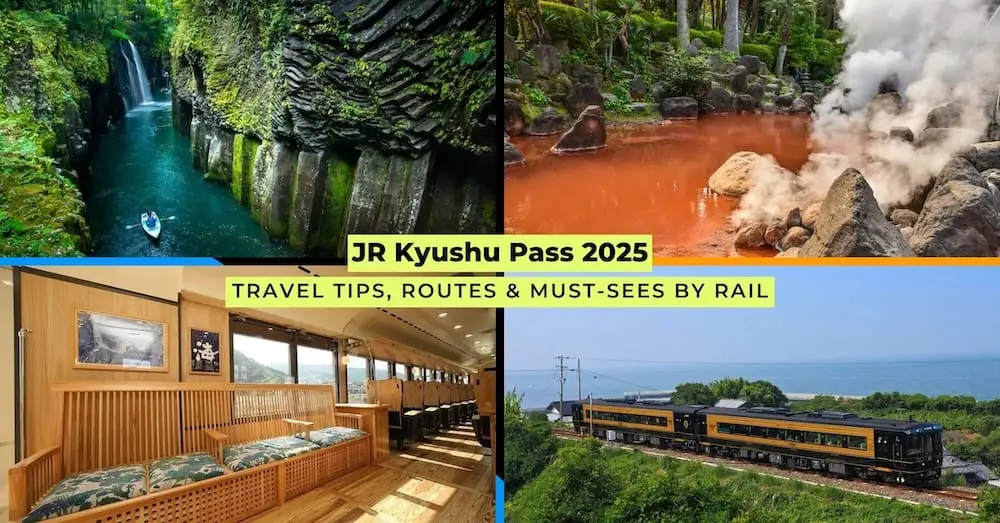
If you’ve spent the year crammed in a sterile office under buzzing fluorescent lights, chances are you’ve daydreamed about escaping to somewhere wild — like Kyushu.
And why not? This incredible island is one of the reasons Japan is so wonderfully diverse.
Think rugged active volcanoes, sweeping subtropical coastlines, and forests so green they look photoshopped.
If you’re heading to Kyushu anytime soon, the best way to explore it all?
The JR Kyushu Rail Pass.
In this guide, we’ll break down the different types — from the All Kyushu to the Northern and Southern passes — and help you figure out which one’s right for your trip.
Let’s go. The Land of Fire is calling.
First Things First: What Is the JR Kyushu Pass?
If you’re new to Japan travel (or already a long-time fan), you probably know a thing or two about the country’s legendary train system.
And the JR Kyushu Pass — sometimes called the JR Kyushu Rail Pass — is a special regional train pass offered by Japan Railways.
It gives you unlimited rides on JR trains across Kyushu, making it super easy to explore the island.
Just like the Japan Rail Pass, it’s only available to foreign tourists on a temporary visitor visa. If you’re a Japanese resident, this one’s sadly not for you.
But if you’re eligible, it’s your golden ticket to hop on and off JR trains freely and experience the best of Southern Japan at your own pace.
So, what exactly does it cover — and where can it take you?
JR Kyushu Pass Coverage: What Can You Ride?
The word unlimited definitely sounds like a sweet deal — and with the JR Kyushu Pass, it mostly is. But there are a few transport types it doesn't cover.
So, what exactly can you ride?
✅ What’s Included:
Local trains
Rapid trains
Limited express trains, including iconic ones like the Yufuin no Mori
The Kyushu Shinkansen and the new Nishi Kyushu Shinkansen (opened in 2022)
Design & Story Trains – JR Kyushu’s sightseeing trains, perfect for train lovers
🚫 What’s Not Included:
Subways, city buses, private railways, and other non-JR lines (e.g. you can't use it for the Fukuoka subway or the Kagoshima tram)
The Sanyo Shinkansen between Hakata and Kokura
Luxury tourist trains like the “Seven Stars in Kyushu” and the ARU RESSHA “sweets” train
That said, the pass covers most regular and limited express JR trains across the island.
It’s built for getting between cities, not navigating within them.
But for exploring Kyushu’s highlights, it’s more than enough.
What About the Pass's Validity?
Just like many other train passes in Japan, the JR Kyushu Pass covers travel within a designated area for a set number of consecutive days.
Consecutive is the key word here — the pass is only valid for a specific number of days in a row. You can’t mix and match or skip days in between.
Like other regional passes, validity starts at midnight on the first day of use, no matter what time you activate it.
For example, if you activate a 3-day pass on June 1 at 10am, it will expire at midnight on June 3.
Got the idea? Great — here are a few more things to know:
You can’t pause the pass once it’s activated. It’ll keep running until the final day, even if you don’t ride every day.
You can buy two shorter passes instead of one long one if that works better for your itinerary.
The standard JR Kyushu Pass is valid for ordinary class cars, including both unreserved and reserved seats.
Want to ride in a Green Car (first class)? You’ll need to pay an additional surcharge.
JR Kyushu Prices and Pass Types
The good news? You don’t have to break the bank to purchase a JR Kyushu Rail Pass.
That said, prices vary depending on the pass type and the region it covers.
Pass Options by Region
1. JR Kyushu Pass (All Kyushu)
Yanagawa, Fukuoka
First up, the most comprehensive option — the flagship All Kyushu Pass.
As the name suggests, this pass gives you maximum freedom to explore Japan’s third-largest island.
It’s available in 3-day, 5-day, or 7-day versions, so you can pick the one that suits your itinerary best.
From Hakata to Beppu, this pass can be used for all of Kyushu.
Planning to travel long distances or hop between multiple prefectures?
This one’s for you.
2. JR Kyushu Pass (Northern Kyushu Pass)
Chinoike Jigoku, Beppu
If you’ve got a more focused itinerary centred around northern Kyushu, this pass is your go-to.
The Northern Kyushu Pass comes in 3-day or 5-day versions and is perfect if you’re heading to places like Fukuoka, Nagasaki, Kumamoto, and the hot spring towns of Oita Prefecture (think Beppu and Yufuin).
3. JR Kyushu Pass (Southern Kyushu Pass)
Sakurajima volcano in Kagoshima
Just like its northern counterpart, the Southern Kyushu Pass covers the bottom half of the island.
One caveat?
It’s only available as a 3-day pass — there’s no 5-day option.
This pass lets you explore Kumamoto, Miyazaki, and Kagoshima.
But heads up: it doesn’t cover anything north of Oita or Kumamoto. So if Fukuoka or Nagasaki are on your list, this one won’t cut it.
It’s the cheapest pass of the three — but geographically, it’s definitely the most limited.
JR Kyushu Pass Prices (2026)
Here’s a quick breakdown of pass types, durations, and prices.
All passes include unlimited rides in ordinary class.
Children (6–11): Half price
Kids under 6: Ride free (no seat required)
Pass Type | Duration | Price |
3 days | 22,000 yen (USD 154) | |
5 days | 24,000 yen (USD 168) | |
7 days | 26,000 yen (USD 182) | |
3 days | 15,000 yen (USD 105) | |
5 days | 17,000 yen (USD 119) | |
3 days | 12,000 yen (USD 84) |
Prices are accurate as of March 2026 but may be subject to change. Please check the updated rates before your trip.
As you can see, it pays to know your route.
If your trip is mostly in the north, the Northern Kyushu Pass is significantly cheaper than the All Kyushu option.
Still, the All Kyushu Pass holds a special place in our hearts — even as the priciest choice.
If you’re doing a big loop around the island, it’s absolutely worth it.
Where to Buy the JR Kyushu Pass
Photo: @tiraxteacher on Instagram
Buying the pass is easy. Here are your best options:
1. Online via JR Kyushu (Official Site)
The official JR Kyushu website accepts credit cards and is straightforward to use.
After purchase, you'll receive a confirmation (a QR code or exchange voucher) which you’ll need to physically exchange for the pass once in Japan.
One key perk: you can reserve seats in advance via their system.
That said, prices are fixed — and resellers often offer better value.
2. Through Travel Agencies (Outside Japan)
Arguably the most popular and convenient method.
You can pay in your local currency (no yen conversion headaches)
Platforms like Pelago offer extra perks like KrisFlyer miles for every dollar spent and special promo codes
Seat reservations? No worries — you can still book them in person at JR stations or online once you’re in Japan.
3. At JR Stations in Japan
You can also buy the pass on the spot at major JR Kyushu ticket counters.
Look for Midori no Madoguchi offices at stations like Hakata (Fukuoka), Kumamoto, Nagasaki, Beppu, and Kagoshima-Chuo.
It’s a solid last-minute option, but keep in mind:
Office hours usually run from 6:30am to 7 to 8pm
Queues can get long during peak travel periods — not ideal if you’re short on time
Official JR Kyushu Pass Exchange Locations
Hakata Station
Kokura Station
Mojikō Station
Saga Station
Nagasaki Station
Kumamoto Station
Ōita Station
Beppu Station
Miyazaki Station
Kagoshima-Chūō Station
Fukuoka Airport International Terminal
Coming from other parts of Japan into Kyushu? Then getting the full Japan Rail Pass might make more sense for you.
JR Kyushu Railway Pass Map: Route Planning for the Train Pass
Whether you’ve got Indiana Jones-level map skills or you’re more of a Dora the Explorer, having a solid map is essential when planning your JR Kyushu adventure.
The good news? You can easily download the JR Kyushu network map online.
Prefer something more old-school? Printed leaflet maps are available at major station counters across Kyushu.
Here are the key JR Kyushu train maps to help you plan your route:
JR All Kyushu Area Pass Map
Photo: Kyushu Railway Company
JR Northern Kyushu Area Pass Map
Photo: Kyushu Railway Company
JR Southern Kyushu Area Pass Map
Photo: Kyushu Railway Company
Map reading not your thing?
No worries — here are a few simple tips to help guide your route planning:
The Shinkansen line (from Hakata to Kagoshima-Chūō) is the backbone of north–south travel. It’s the fastest way to move between cities — around 2 hours on the Sakura service.
JR lines don’t reach every town — especially in eastern Miyazaki and southern Kagoshima, where coverage is thinner.
The Hisatsu Line between Yatsushiro and Hitoyoshi is still under restoration after flood damage in 2020, so check for updates before your trip.
Seat Reservation Tips
Ibusuki no Tamatebako
If you’re planning to ride limited express trains — including iconic “Design & Story” trains like:
the sumptuously retro Yufuin no Mori
the super kid-friendly Aso Boy!, which even has a built-in playground
the Ibusuki no Tamatebako, inspired by the Dragon’s Palace folktale from the Satsuma Peninsula
and the Hayato no Kaze, a restored two-car scenic diesel train in Kagoshima
...then it’s best to make seat reservations in advance. These trains are popular and tend to fill up, especially during peak travel periods.
As for the Shinkansen — if you’re travelling with large luggage, reservations are also highly recommended.
Local and rapid trains, on the other hand, don’t require reservations at all.
If you’re using the All Kyushu Pass, good news: you can make unlimited seat reservations. No stress — you could reserve every train on your itinerary if you wanted.
But with the Northern Kyushu Pass or Southern Kyushu Pass, free reservations are capped at six — so plan ahead.
Need help? We’ve got a separate guide on how to reserve seats with your JR Pass — step by step.
Is the JR Kyushu Pass Worth It?
Oh, totally — that's the million-yen question for any rail pass.
The JR Kyushu Pass, in particular, can offer great value.
But of course, it depends on your itinerary and personal travel style.
Cost-wise, there are plenty of ways to make it worth your while.
For perspective: a round-trip Shinkansen ticket from Fukuoka to Kagoshima costs around 21,000 yen — nearly the same as the 3-day All Kyushu Pass (22,000 yen).
So really, the pass can pay off with just one or two long-distance journeys. If you’re making multiple trips, you’ll definitely get more bang for your buck.
Take a look at the example below:
Sample Route Comparison
Day | Route | Train Type | Approx. Fare (One-way) |
1 | Fukuoka → Kagoshima-Chūō | Kyushu Shinkansen | 10,500 yen |
2 | Kagoshima-Chūō → Miyazaki | Limited Express Kirishima | 5,500 yen |
3 | Miyazaki → Beppu | Limited Express Nichirin | 5,500 yen |
4 | Beppu → Nagasaki | Limited Express + Relay | 6,500 yen |
5 | Nagasaki → Fukuoka | Nishi Kyushu Shinkansen | 5,500 yen |
Total (without pass): | 33,500 yen |
As you can see, these journeys would cost around 33,500 yen if paid individually.
But with a 7-day All Kyushu Pass (26,000 yen), you’d save at least 7,500 yen — and that’s not even including any side trips.
So yes, the pass is absolutely worth it.
🚆 JR Kyushu Rail Pass Itineraries and Sample Routes
Here’s how to make the most of your JR Kyushu Pass — whether you’ve got 3 days or 5.
Each route is built for convenience, value, and maximum highlights. It might feel a bit packed for some, but the goal is to show you what’s possible.
Feel free to tweak the itinerary to match your own pace and travel style.
🧭 3-Day Northern Kyushu Itinerary
Mount Kishima
Best with: 3-Day Northern Kyushu Pass
Ideal for: Short trips based in Fukuoka
Day | Route | Highlights |
1 | Fukuoka → Nagasaki | Peace Park, Dejima, Mount Inasa night view |
2 | Nagasaki → Kumamoto | Kumamoto Castle, Suizenji Garden, local ramen |
3 | Kumamoto → Aso → Beppu → Fukuoka | Aso volcano views, Beppu hot springs, return to Fukuoka |
✂️ Trim option: Skip Aso for a slower Beppu visit, or stop at Dazaifu on the way back.
🚄 5-Day All Kyushu Itinerary
Takachiho Gorge
Best with: 5-Day All Kyushu Pass
Ideal for: Travellers covering all major regions
Day | Route | Highlights |
1 | Fukuoka → Kagoshima | Sakurajima, Sengan-en Garden, black pork (kurobuta) |
2 | Kagoshima → Miyazaki | Aoshima Island, coastal train ride, shrine hopping |
3 | Miyazaki → Beppu | Beppu Hells, sand bath, optional Yufuin stop |
4 | Beppu → Nagasaki | Peace Park, castella cake, hillside harbour views |
5 | Nagasaki → Fukuoka (+ side trip) | Dazaifu or Yanagawa, wrap up with Fukuoka street food |
✈️ Tip: Arrive and depart from different cities to avoid backtracking.
(Also, note: The JR Kyushu Pass doesn’t cover transport to Dazaifu or Yanagawa, as they’re on private rail lines — small out-of-pocket fares apply.)
🌋 3-Day Southern Kyushu Itinerary
Kagoshima city
Best with: 3-Day Southern Kyushu Pass
Ideal for: Visitors starting in Kagoshima or focusing on the south
Day | Route | Highlights |
1 | Kagoshima city | Sakurajima ferry, lava trails, samurai garden |
2 | Kagoshima → Miyazaki | Kirishima scenery, Aoshima beach shrine, chicken nanban |
3 | Miyazaki → Kumamoto | Scenic rail ride, Kumamoto Castle (optional) |
🧭 Note: This pass doesn’t cover Fukuoka or the north — plan regionally.
Best Things to Do in Kyushu: Must-See Spots
There are so many epic things to do in Kyushu that it’s hard to narrow things down. But if you’ve only got limited time, here are some must-visit places to check off your list:
Takachiho Gorge
TikTok-famous — and for good reason.
This stunning volcanic gorge features dramatic cliffs, lush greenery, and a waterfall you can row a boat beneath.
It’s not just social media fodder; it’s a true feast for the senses, with rainbow-misted falls, nearby shrines, and cosy local inns. A bona fide Kyushu gem — and 100% worth a day tour.
7 Hells of Beppu
Don’t be intimidated by the name — these “hells” are boiling hot springs meant for viewing, not bathing. Each one is a different colour and personality, like something out of an anime. Highlights include:
Umi Jigoku (Sea Hell) – a cobalt blue, steaming pond
Bozu Jigoku (Shaven Monk’s Head Hell) – bubbling grey mud
Chinoike Jigoku (Blood Pond Hell) – a crimson pool coloured by iron-rich water
You can pre-book your Beppu Hell Tour admission tickets before visiting.
Kumamoto Castle
As far as Japanese castles go, they don’t get more dramatic than Kumamoto Castle.
Towering on a hilltop and rebuilt after the 2016 earthquake, it reopened in 2021 with restored areas now open to visitors.
Some sections remain closed, but the castle grounds alone are worth exploring — ideally with a guide to fully appreciate its history and scale.
Huis Ten Bosch
For something truly quirky, this Dutch-themed park in Nagasaki Prefecture serves up windmills, tulips, canals, and cobblestone streets.
Think: Europe meets Japan.
Attractions include a Ferris wheel, haunted house, mirror maze, and a replica of the Domtoren (Dom Tower) in Utrecht with sweeping 360° views.
Pre-book your Huis Ten Bosch admission tickets for a smoother visit.
Mount Aso
Kyushu has nine active volcanoes — and Mount Aso is the king of them all.
Adventurers can hike to the peak in about 90 minutes, though it’s a steep and challenging climb.
For a more accessible option, head to Daikanbo Viewpoint, just a short stroll from the car park, offering jaw-dropping views of Aso’s massive caldera.
Either way, the scenery is unforgettable.
Nagasaki Atomic Bomb Museum
Sobering and powerful, this museum offers a deeply moving look at the horrors of war.
Built to honour the victims and survivors of the atomic bomb dropped on Nagasaki in 1945, the museum is a smaller, quieter alternative to Hiroshima’s Peace Museum — but no less impactful.
A must-visit for those interested in history and remembrance.
JR Kyushu Rail Pass vs Other Kyushu Travel Passes
So, you might be thinking: Kyushu’s got all the rail passes — job done, transport sorted.
Not quite.
Kyushu actually offers more than just JR train passes for getting around.
Here are some alternatives you might want to consider — and when it makes sense to choose one over the other.
JR Kyushu Rail Pass vs SunQ Pass
More of a bus person than a train enthusiast?
Then the SunQ Pass — Kyushu’s de facto bus pass — might be right up your alley.
Like the JR passes, it offers unlimited travel across all seven Kyushu prefectures (plus a slice of Shimonoseki) — but on buses instead of trains.
Photo: @discover_nagasaki on Instagram
There are 2-day, 3-day, and 4-day versions available.
Each pass covers:
Highway buses
Local buses from most major companies
Some ferries (including routes to Shimonoseki and even Uwajima in Shikoku)
Why choose this over JR?
It gets you to rural areas that JR trains don’t reach.
Some trips are faster by bus — like Fukuoka to Miyazaki (4.5 hours by bus vs 5.5+ by train with transfers).
That said, if comfort is your priority, long-distance buses on winding, mountainous roads might feel less pleasant than trains.
Still, Japan’s buses are excellent — clean, punctual, and safe. You won’t be stuck on anything that looks like it’s falling apart.
JR Kyushu Rail Pass vs the Kyushu Expressway Pass (KEP)
Bet you didn’t know Kyushu had driving passes too.
Yep, that’s right.
The Kyushu Expressway Pass (KEP) offers unlimited use of Kyushu’s expressway toll roads for a flat rate — exclusively for foreign visitors renting a car.
Prices range from 3,600 yen for 2 days to around 11,700 yen for 10 days.
You might be wondering — do you really need this?
Well, consider this: highway tolls in Japan are notoriously pricey (sometimes up to 5,000 yen for a single long-distance trip). The KEP lets you drive all over Kyushu without paying tolls each time. It’s a solid deal if you're planning a self-drive trip.
Just remember — you’ll need an International Driving Permit (IDP) to rent a car in Japan. No permit, no rental.
Not into driving? No worries. You can always charter a private car instead — a little more comfort and a lot more convenience.
Final Thoughts: All Aboard for Kyushu
At the end of the day, the JR Kyushu Rail Pass is your all-access ticket to unlock this wild, wonderful island — whether you’re zipping between Kumamoto and Kagoshima-Chūō on the bullet train, or riding scenic limited express trains deep into Miyazaki.
You’ll get to explore within the designated area of your chosen pass — whether that’s northern Kyushu, southern Kyushu, or the whole island — and enjoy the convenience of unlimited rides on most train lines, including shinkansen segments and non-reserved seats on regular services.
Just flash your passport when you pick up your pass at the JR counter, and you’re good to go.
And remember: some things cannot be used with the JR Pass — like city buses or private railways — so check ahead. But with so much ground to cover and so many places to explore, there’s really no better way to travel than by rail in Kyushu.