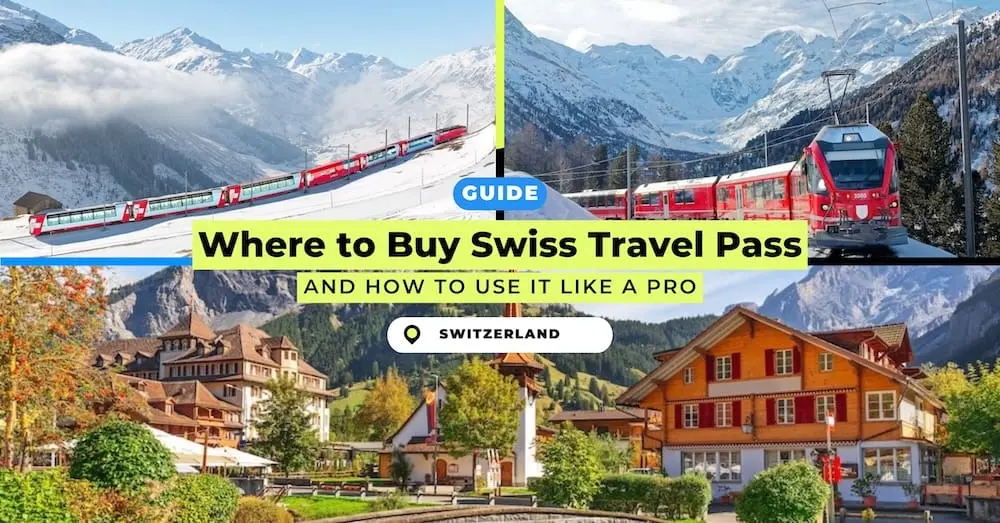
When it comes to a world-class transport system, there’s no question.
Switzerland is right up there.
Those 4K clips you see on YouTube - with nearly floor-to-ceiling windows showing expansive views of the Alps - aren’t an exaggeration. Instagram is reality here.
And the best way to travel the country? That’d be the all-in-one Swiss Travel Pass (also called the Swiss Rail Pass by folks).
In this guide, we’ll deep-dive into where and how you can buy the Swiss Travel Pass, how to activate and use it, and whether it’s worth forking out for in the first place.
Here we go:
So, What Is the Swiss Travel Pass Exactly?
Well, think of it as pretty much a golden ticket for unlimited travel on nearly all types of Swiss transport.
We’re talking trips by train, bus, and boat. All free (or heavily discounted for certain journeys). All for a set number of days.
Similar to the Japan Rail Pass in Japan, this pass is only available for non-residents. Basically, tourists. (Swiss citizens use a separate system.)
You can buy the pass in durations of:
3 days
4 days
6 days
8 days
Or 15 consecutive days
Benefits of the Swiss Travel Pass
Extensive coverage and convenience: With this pass, you’ll get to explore every nook and cranny of the country. It covers all Swiss Travel System routes, including premium panoramic trains. Plus, there’s the convenience of simply flashing your pass and boarding any included bus or train without shelling out cash for tickets each time.
Free city transport: This sounds like a dream come true. And it really is. With the Swiss Rail Pass, you can travel free of charge on local public transport like trams and buses in 90 towns and cities. Getting around places like Geneva, Lucerne, Interlaken, or Zurich will be a cinch.
500+ museums free: More than just train travel, the pass also doubles as a Museum Pass. You can enjoy free admission to over 500 museums and attractions, spanning historical sites to art galleries. For example, the Château de Chillon or Thun Castle museum.
Mountain transport discounts: Everyone likes a discount, right? And this travel pass comes with plenty. Think 50% off most mountain cable cars, cogwheel trains, and funiculars that whisk you up to alpine peaks. A few are even completely free. Like Mount Rigi, Stanserhorn (CabriO cable car), and the Stoos funicular and cable car.
Free travel for kids: Parents with young families, rejoice. Children aged 6 and under always travel free, even without a pass, when accompanied by at least one parent holding a valid ticket. And kids aged 6 to 15 can travel free of charge when you add the Swiss Family Card to your booking (which is free)!
Where to Buy the Swiss Travel Pass
You’re more or less spoilt for choice when it comes to options for buying the Swiss Travel Pass online and in-person.
You can get it directly from SBB.ch, the official Swiss Federal Railways website or online travel platforms like Pelago.
Other options include:
The Switzerland Tourism website
Any staffed train station in Switzerland
Directly at Zurich Airport
Partners listed on the SBB website
Rail Europe
HappyRail
Of course, prices are standardised. There’s really no such thing as getting the “cheapest Swiss Travel Pass.”
How affordable it feels depends on your travel style and itinerary. Say, whether you’re taking long trips or planning to enter more museums.
That said, there are ways to maximise your spend beyond just discounts on the pass.
For example, are you chasing KrisFlyer miles? Are you dreaming of redeeming a dream business class or first class flight?
Then a big-ticket purchase like the Swiss Travel Pass is a neat way to rack up miles.
The base fare of SGD 748 nets you 2,223 miles alone if you book the pass on Pelago. And that’s not even counting the miles you’ll naturally earn on your credit card spend (especially if you’re using a solid miles credit card).
Just be careful: there have been reports of scam sites impersonating official sellers. All credible retailers will ultimately issue you an official Swiss Travel Pass ticket or e-pass with a QR code. Keep that in mind before you click buy.
How to Buy Your Swiss Travel Pass
You probably want to start with the basics: like how much does it cost, and where can you buy it?
Swiss Travel Pass Prices (2026)
Pass Duration | Adult 2nd Class | Adult 1st Class |
|---|---|---|
CHF 254 (USD 323.98) | CHF 430 (USD 548.8) | |
CHF 328 (USD 418.72) | CHF 522 (USD 666.69) | |
CHF 423 (USD 540.67) | CHF 672 (USD 859.1) | |
CHF 466 (USD 944.48) | CHF 739 (USD 594.87) | |
CHF 529 (USD 676.18 | CHF 834 (USD 1066.43) |
Prices are accurate as of March 2026. Always double-check before your trip, as they can change.
Buying the Pass Online
If you buy through Pelago (or another official site), you’ll first pick your pass type - consecutive or flex - then choose duration and class.
Once you’ve paid, you’ll get a confirmation email with a PDF ticket and QR code. This PDF is your Swiss Travel Pass.
Print it if you like, but saving it to your phone works just fine. Pro tip: download it offline, since mountain internet can be patchy.
Buying at a Station
Buying in person is just as easy. Head to the ticket counter, ask for your pass, and set your start date (today or any date within the next six months).
The staff will likely ask for your passport to confirm you’re a tourist.
You’ll leave with a paper pass, which works exactly like the digital one.
Once you’ve bought your pass, the next step is activation. Here’s how it works:
How to Activate the Swiss Travel Pass
Here’s the good news: Consecutive Passes don’t need any extra steps.
If you bought online, your pass activates automatically on your chosen start date.
If you bought at a station, the clerk will have already printed or stamped the date for you.
Simply carry your pass and show the QR code when the conductor checks.
Validity Tip
Your pass runs until 5am the next day. That means overnight trains are included.
Example: Buy an 8-day pass starting 1 July → valid through 8 July. You can still catch a night train on the 8th, as the pass stays valid until 5am on 9 July.
For Flexible Passes
The Swiss Travel Pass Flex works differently. You’ll need to activate each travel day.
Here’s how:
Go to www.activateyourpass.com.
Enter your details and pick your travel date.
You’ll get an e-ticket with a QR code for that day.
After that, you can hop on trains, buses, and boats as normal. And reserve panoramic trains through official sites if you want.
SBB App: A Real Must-Have
Do yourself a favour and download the SBB Mobile app. It comes with integrated maps and real-time public transport updates - like timetable changes or route disruptions. You can even personalise your travel planning. We couldn’t recommend this highly enough. Get it on the App Store or Play Store.
Pro tip: Wondering if you need to add your Swiss Travel Pass PDF to the app? You don’t. The PDF itself is enough. The only way to “link” it is if you purchase the pass directly through the SBB app.
Swiss Travel Pass Coverage: What Does It Include?
What doesn’t the Swiss Travel Pass include? That’s the real question.
Because the Swiss Travel Pass coverage is broad. That’s one of its biggest advantages.
But okay, let’s get into specifics.
Here’s what the Swiss Travel Pass includes:
Swiss Travel Pass Train Coverage
On to train coverage.
Any self-respecting Swiss Travel Pass itinerary has to involve trains. Why?
All regular scheduled trains operated by the major Swiss railway companies are covered. That means InterCity, InterRegio, regional, and suburban trains are all included.
You can zip between Interlaken and Zermatt at no extra cost. And then there are the famous panoramic trains: the Glacier Express, Bernina Express, Gotthard Panorama Express, and GoldenPass Line.
The Glacier Express is especially iconic as the “slowest express train in the world.” It’s an epic 8-hour journey through 291 bridges and 91 tunnels, with near floor-to-ceiling windows serving up wallpaper-worthy views.
The Bernina Express’s Rhaetian Route is no less jaw-dropping. It’s a train that takes you through a UNESCO World Heritage Site that climbs to Europe’s highest railway tracks - up to 2,253 metres (7,392 feet) at Ospizio Bernina, the highest train station on the continent.
The Gotthard Panorama Express mixes things up with a historic steamboat cruise across Lake Lucerne before whisking you down to Switzerland’s Mediterranean south on a first-class only train.
And the GoldenPass Line gives you sumptuous views of the Bernese Highlands - think towering peaks, rolling pastures, and glimmering lakes.
Other Routes Covered
Cross-city train travel - like Geneva to Zurich or Zurich to Lucerne
Scenic regional lines in the Alps
The entire SBB rail network, plus many private rail companies
Here are a few other train routes worth adding to your trip that you can get discounts on with your Swiss Travel Pass:
Pro tip: Check the official Swiss Travel Pass map before your trip. Or print it out if you prefer. You can download the PDF version here.
Swiss Travel Pass Bus Coverage
The Swiss Travel Pass isn’t just about trains. It’s got you covered on buses too.
PostBus routes: Every yellow PostBus in Switzerland is included.
Regional buses: Most local bus lines fall under the pass.
City transport: Buses and trams in 90 towns and cities - from Zurich to Lucerne - are covered with the Swiss Travel Pass.
Chances are you’ll use buses more than you expect, especially if you’re the off-the-beaten-path type. They reach villages and valleys that trains don’t, particularly in mountain regions.
The only catch? A handful of tiny private shuttles or remote mountain buses may not be covered. But those are rare. If in doubt, open the SBB app and check the “GA travelcard” validity. It’ll tell you instantly if your pass works.
Swiss Travel Pass Boat Rides
The great thing about the pass is you get to travel by train, bus, and boats or ferries too.
All the major lakes - Lake Lucerne, Lake Geneva, Lake Zurich, Lake Thun, Lake Lugano, and Lake Brienz - are covered.
You can easily spend a day hopping on and off paddle steamers on Lake Lucerne, for example.
Regular boat tours that are part of public transportation are also free.
You can even take the ferry between Lausanne and Évian in France at a discounted rate.
Smaller ferries on Lake Zurich and Lake Zug are included too.
The only exception? Special dinner or event cruises, like private Geneva boat tours with alcoholic beverages.
Swiss Museum Pass
Here’s a perk many travellers overlook: the Swiss Travel Pass doubles as a museum pass. And not just for a handful. It covers more than 500 museums across the country.
You’d be hard-pressed to find another pass this extensive.
With it, you can walk into some of Switzerland’s top cultural landmarks for free, including:
Swiss Museum of Transport, Lucerne - one of the country’s best and most family-friendly museums
Kunsthaus Zurich - home to a world-class art collection
Château de Chillon, Lake Geneva - a historic lakeside castle that feels straight out of a fairytale
Ballenberg Open-Air Museum - showcasing traditional Swiss life in the Bernese countryside
Patek Philippe Museum, Geneva - a must for watch lovers
And that’s just the start. The pass also opens doors to countless local galleries, historic houses, and alpine valley museums you’d probably never discover otherwise.
Mountain Railways and Cable Cars
First, a quick distinction: mountain railways aren’t the same as regular trains.
These are specialised lines built for steep inclines. They’re mostly scenic journeys designed for travellers. And yes, they deliver blockbuster views on mountain excursions.
A valid Swiss Travel Pass is available for many of them, but there are limits. Some rides are free, some are 50% off, and a few are only discounted 25%.
50% Off with the Pass
Mt. Titlis cable car from Engelberg
Gornergrat Railway in Zermatt
Matterhorn Glacier Paradise cable car
Pilatus cable car and cogwheel train (fully included if you book a day tour)
25% Off with the Pass
Jungfraujoch saddle, linking two 4,000-metre peaks in the Bernese Alps
New Eiger Express Gondola
Free with the Pass
Stanserhorn CabriO cableway and funicular
Stoos funicular
Pro tip: You’ll still need a separate ticket for mountain rides, unless they’re fully covered. Always double-check before you board.
Seat Reservation Fees & Panorama Trains
Here’s something that catches many first-timers off guard: your Swiss Travel Pass covers the fare on Switzerland’s famous panoramic trains - but not the seat reservations.
What this means in practice:
Glacier Express - fare (CHF 150) included, but you’ll still pay CHF 39-49 for the reservation (class and season dependent).
Bernina Express - about CHF 20.
GoldenPass Express - CHF 20.
Gotthard Panorama Express - similar range.
For regular intercity and regional trains, no reservation needed. Just hop on and sit where you like. If you’re travelling at rush hour and want peace of mind, you can reserve a seat for CHF 5. Totally optional.
Swiss Travel Pass First Class vs Second Class
Photo: @thegingerwanderlust on Instagram
Now, the million-franc question: should you go first or second class?
Second class is excellent. Clean, comfy, and what most travellers choose. You’ll rarely feel short-changed.
First class does raise the bar. Think:
Wider seats
More personal space
Quieter coaches with a calmer vibe
Access to some panoramic lounges you can’t enter with a second-class pass
Is it worth the upgrade? Depends on when you’re travelling. In high summer, when second class fills fast, first class feels like a luxury. In spring or autumn, second class usually has plenty of room.
Pro tip: Even with a 2nd class pass, you can splurge on one leg by buying a one-off first-class upgrade. Save it for a scenic route, then switch back.
Refunds & Cancellations
Here’s the fine print on Swiss Travel Pass refunds and cancellations:
After activation: non-refundable, no exceptions.
Unused passes: some sellers may allow refunds (often with a fee). Always check the Swiss Travel Pass cancellation policy where you buy.
E-passes: stricter - once issued, many are non-refundable.
Paper passes: unused may be refundable, but expect admin fees and to return the original ticket.
Travel insurance: can sometimes cover you if you can’t travel for a valid reason.
Bottom line: finalise your dates before you purchase.
Is the Swiss Travel Pass Worth It?
So, the big one: is a multi-day Swiss Travel Pass actually worth it?
Mostly, yes. But it depends on your trip and how much you're moving about on the Swiss travel network.
It’s worth it if you:
Are hopping between cities every couple of days.
Love the freedom to take spontaneous detours - a lake cruise here, a museum stop there.
Are travelling with kids (the Family Card makes it unbeatable).
Prefer convenience over doing ticket maths at every station.
Maybe not worth it if you:
Plan to stay in one region only.
Are focused mainly on mountain trips (where the Half Fare Card’s 50% often beats the pass’s 25%).
Are on a shoestring budget and don’t mind juggling point-to-point tickets.
Swiss Travel Pass vs Swiss Half Fare Card
Glacier Express panoramic train
We’ve covered what the Swiss Travel Pass offers. But what about the Swiss Half Fare Card?
Here’s how it works:
You buy the card for a fixed price (CHF 120, valid for one month).
From then on, you get 50% off almost all trains, buses, boats, and mountain rides across Switzerland.
There’s no unlimited travel - you still buy individual tickets - but at half the cost.
When does it win over the Swiss Travel Pass?
If you’re not travelling every day.
If your focus is on expensive mountain excursions, where the Half Fare Card usually beats the Swiss Travel Pass discounts.
If you prefer flexibility and don’t mind buying tickets for each ride.
In short:
A Swiss Travel Pass = convenience, spontaneity, and all-in-one freedom.
A Half Fare Card = flexibility and better value if your trip is lighter or mountain-heavy.
We have a full guide on the Swiss Half Fare Card vs the Swiss Travel Pass if you're keen to explore both passes in more detail.
Final Word on the Swiss Travel Pass
Here’s the truth: the Swiss Travel Pass isn’t about squeezing every last franc. It’s about freedom.
Unlimited rides. No ticket queues. The joy of hopping on a boat or train simply because you feel like it.
If your trip is packed and wide-ranging, the pass is a game-changer. If it’s slower and more regional, the Half Fare Card may be the smarter move.
Either way, Switzerland’s transport system is world-class. And that’s no exaggeration.
Wondering where to make the most of your travel pass? We’ve rounded up the best train rides to add to your Swiss bucket list, pronto!
🚄 More Rail Passes for Your Europe Adventure
Now that you’ve mastered the Swiss Travel Pass, here are a few handy passes to help you roll smoothly into Europe:
Stay flexible across 33 countries with the Eurail Global Pass Flex for choose-your-day travel.
Go all-in on a long Europe route with the Eurail Global Pass (Consecutive Days) for uninterrupted daily rides.
Keep family travel simple with the Eurail Global Pass Family Card (Non-Consecutive Days), where kids ride free on your selected days.
Prefer back-to-back exploring? The Eurail Global Pass Family Card (Consecutive Days) covers the whole family on continuous travel days.
Heading to France next? The Eurail France Pass gives you unlimited rides across the country’s top routes.