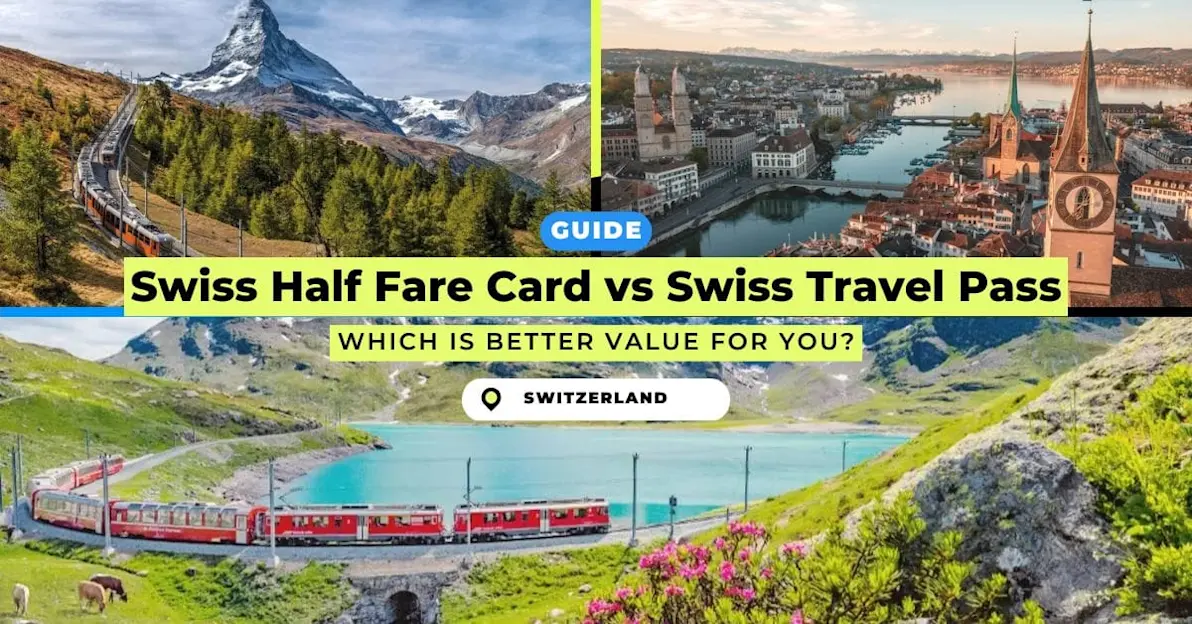
You’ve decided: Switzerland by rail is the way to go.
Time to finally tick that bucket list. Crystal-clear lakes flashing by. Snowy peaks on every horizon. Plush trains that run like clockwork.
What’s not to love?
The tricky part?
Choosing between the Swiss Travel Pass and the Swiss Half Fare Card and figuring out which is better.
For example, which one saves you more money? Which makes your trip hassle-free?
Not to worry.
This guide shows what each pass includes, who it suits, how scenic trains and mountains are covered - and where each one wins.
Differences Between Swiss Travel Pass & Half Fare Card
Okay, let's compare these two Swiss travel passes in the table below, so you can weigh and measure the benefits and drawbacks easily.
Swiss Travel Pass vs Half Fare Card Feature Breakdown
The Basics | ||
|---|---|---|
Price | Pay once and ride as much as you like for 3, 4, 6, 8 or 15 days. Flex lets you spread days across a month. Youth discounts and First/Second Class options available. For tourists only. | CHF 120 for 1 month. After that, every train, bus, boat, and most mountain rides are 50% off. For tourists only. |
Coverage & perks | Unlimited trains, buses, boats, and city transport in 90+ towns. Free entry to 500+ museums. Panorama routes covered (reservation extra). Some mountains free; most others 50% off. | Always half price on almost all public transport and mountain lifts. No extra museum perks. |
Ease vs effort | Flash your pass and go. Perfect for spontaneous trips and hassle-free days. | Buy a half-price ticket each ride. Quick on the SBB app. Best if you don’t mind a little planning. |
When it wins | Ideal for short, busy trips packed with city hops, ferries, and museums. Families love the no-fuss vibe. | Great for longer, slower trips with fewer big rides. Especially good if mountains are your main goal (like Jungfraujoch). |
Now we're done putting them side by side, let's deep dive into the specifics.
So you can finally decide which Swiss travel pass to buy.
What Is the Swiss Travel Pass?
Out of all of Switzerland's train pass options, this one’s the most comprehensive.
And honestly, the easiest to wrap your head around.
Logistically, the Swiss Travel Pass is a no-brainer.
It covers almost every route in the country (we’ll dive into the details later), and it delivers solid value for money.
What's Included in the Swiss Travel Pass
One pass. Nearly the whole country. That’s the simplest way to describe it.
While the Swiss Half Fare Card is all about discounts, the Swiss Travel Pass gives you unlimited travel on trains, buses, and boats.
Nationwide.
You can also hop on local transport in over 90 towns and cities - perfect for those off-the-beaten-path adventures.
And then there are the iconic panoramic routes like the Glacier Express and Bernina Express. They’re covered too (just note you’ll need to pay a little extra for seat reservations).
That’s still not everything.
The pass includes free entry to 500+ museums - a criminally underrated perk that most travellers don’t use enough.
Plus, you get free access to mountain railways like Rigi, Stanserhorn, and Stoos, and a sweet 50% discount on most others.
Here’s a quick look at where the Swiss Travel Pass can take you:
While you’re at it, don’t miss the panoramic train routes that crisscross Switzerland’s most scenic regions. Check them out below:
And if you’re planning to go beyond the famous panoramic lines, there are other special train journeys worth adding to your trip. They’re not completely free, but you can enjoy discounted fares with the Swiss Travel Pass.
Swiss Travel Pass Prices (2025)
Pass Duration | Adult 2nd Class | Adult 1st Class |
|---|---|---|
CHF 248 (USD 312) | CHF 395 (USD 497) | |
CHF 300 (USD 377) | CHF 469 (USD 592) | |
CHF 385 (USD 484) | CHF 611 (USD 770) | |
CHF 426 (USD 536) | CHF 665 (USD 839) | |
CHF 466 (USD 587) | CHF 734 (USD 924) |
Swiss Travel Pass Validity and Duration
With the Swiss Travel Pass, you have the option of picking between 3, 4, 6, 8, or 15 consecutive days, or the Swiss Travel Pass Flex.
The latter is, as its name suggests, you can pick the same number of days but spread it across one month.
Swiss Travel Pass First Class vs Second Class
Photo: @thegingerwanderlust on Instagram
We're talking about Switzerland here, so second class is already super cushy.
But if you're thinking of living it up and are ready to splash the cash, then of course, you get what you pay for.
First class buys you more space, quieter cars, and upper decks on some boats.
Very nice but hardly necessary.
Of course, if you're on a 10-year anniversary or going to propose on the trip, then first class is always a nice touch.
Seat Reservations - When and Where They’re Required
Well, you technically don’t need reservations on regular Swiss trains.
But you do on certain panoramic trains (think the Glacier, Bernina, Gotthard Panorama Express).
Safe to say, you should budget CHF 10-49 per seat booking depending on train/season.
Essentially, your pass covers the fare; you pay the reservation.
Pro tip: Download the SBB Mobile app beforehand. You won't regret it. The app comes with integrated maps and real-time public transport updates - like timetable changes or route disruptions. Super useful for your travel planning. Get it on the App Store or Google Play.
Want to find out more about the Swiss Travel Pass? We've got a complete guide on where to buy it and how to use it, which may come in handy if you've decided that this is the pass for your trip.
What Is the Swiss Half Fare Card?
Now that we’ve covered the ins-and-outs of the Swiss Travel Pass, let’s switch to the Swiss Half Fare Card.
Think of it as a tourist-friendly discount card. Instead of unlimited travel, you get 50% off most trains, buses, and boat rides.
Every time you buy a ticket, it’s half price. Simple.
You don’t travel free of charge, but here’s the catch.
Depending on your trip and how you plan it, the Half Fare Card can actually save you more money than a full pass.
Let's go into more detail below:
How to Use the Swiss Half Fare Card
So first up, the Swiss Half Fare Card isn't free.
You have to purchase it first, then you get to enjoy 50% discounts across the public network and most mountain railways and cable cars.
All you need to do? Pay CHF 120 once. Then you just need to show your digital card when you buy your tickets at local stations or through the SBB app.
Swiss Half Fare Card Price (2025)
Pass Duration | Price |
|---|---|
CHF 120 (USD 150) |
The pass is valid for 30 days from the first day of validity.
And the good news? Children under 16 years old get to travel free of charge when accompanied by a pass-holding adult passenger with the Swiss Family Card (which is free to add on when you buy your tickets).
As for the not-so-great news?
If you’re travelling in 2026, plan for an increased budget. From 1st January 2026, the Swiss Half Fare Card will increase to CHF 150 (USD 188).
How and Where to Buy the Swiss Half Fare Card
Oh, it's pretty easy.
You can either buy online via the official SBB website or app, or you can get it from online travel platforms like Pelago.
You can also get it in person at any Swiss train station ticket office.
The prices are all the same.
But one benefit of getting it through SBB is that the card will be stored digitally in your profile, and you can easily buy discounted tickets directly in the app.
Talk about convenience, eh.
However, you might still want to consider purchasing your tickets from platforms like Pelago.
If you're flying to Switzerland on Singapore Airlines, you can enjoy discounts with your PNR reference number.
After all, there's technically no "Swiss Half Fare Card promo code" per se. But this is one way to get even more savings before the actual 50% discounts you get on your train tickets.
Not only that.
For folks chasing that next business class or first class flight, here's an opportunity to rack up more miles while on your vacation.
For example, you'll be able to earn KrisFlyer miles at a rate of 3 miles per dollar.
That's a minimum of 1,158 KrisFlyer miles if you buy two tickets. Couple that with the earn rate you get from using the right miles credit cards, and your dream flight will be closer to reality.
Is the Swiss Half Fare Card Worth It, Though?
Absolutely.
Even with the price increase slated for next year, the Swiss Half Fare Card can still save you a ton of cash in many situations.
For example:
If you're taking popular mountain railways like Jungfraujoch, this pass is a lifesaver. Mountain excursions like these can be very expensive without a discount. And the 50% discount will be highly welcome.
You're planning to rent a car. Perhaps you don't want to be taking trains and boats your entire vacation but still want the flexibility of doing so while driving around yourself. The Half Fare Card will save you plenty.
If you have a very chill itinerary with not much hopping around, then the Half Fare Card is sufficient for discounts already. If not, you might feel you'd have to make a Swiss Travel Pass "worth it" by moving around a lot. That wouldn't be the wisest choice.
If you're all about spontaneous travel, then the fact that the Half Fare Card isn't required to be used on consecutive days is actually a real big plus.
But as a rule of thumb, we'd suggest you tally your total cost of all the trips you're making, be it buses, trains, mountain railways, cable cars, or boats.
If your total cost with the Swiss Half Fare Card and the price of all your discounted train tickets is less than a Swiss Travel Pass, then it makes sense to just get the Half Fare Card.
SBB Half Fare Card and Local Variants
Don’t confuse the tourist Swiss Half Fare Card with Swiss residents’ annual “Half Fare Travelcard” on the SwissPass.
You’ll want the tourist version sold to residents abroad.
To be safe, you can always pre-book your pass on Pelago for peace of mind.
Swiss Half Fare Card Route Coverage
Okay, so now we've mostly touched on the buying process - that's settled. And you know you can get a 50% discount on buses, trains, gondola lifts, and boat trips.
But where exactly in Switzerland does the Swiss Half Fare Card cover?
Well, more on that below:
First Up, Is the Glacier Express Included?
The train ticket price isn't entirely covered. But you get a 50% discount on the train ticket price, and you'll still need to fork out for the mandatory seat reservation fee.
Is the Bernina Express Also Covered?
Again, the logic is exactly the same as the Glacier: the Half Fare Card gives you a 50% discount only; your pass still requires reservations, which you'll need to pay a separate seat reservation fee in full.
And Does the Swiss Half Fare Card Cover Jungfraujoch?
Jungfraujoch is a very, very expensive destination.
It is, after all, the highest railway in Europe. Maintaining infrastructure at such extreme altitudes isn’t exactly cheap, y’know.
But to give you an example of how much it can cost, round-trip tickets alone can set you back roughly CHF 200 to 260 (USD 250 to 326).
That's when the Swiss Half Fare Card's 50% discount will be a lifesaver.
In comparison, the Swiss Travel Pass only offers a 25% discount on the journey from Wengen/Grindelwald to Jungfraujoch.
Other options include the Berner Oberland Pass, which gives you a 25% discount on the Jungfraujoch section, and the Jungfrau Unlimited Travel Pass (which we cover more on below), if you're planning to spend multiple days in the region and want to stack your trip with mountain excursions. For example, Grindelwald, Männlichen, and Mürren.
Other Scenic Trains the Half Fare Card Entitles You To
Rigi: You get 50% off all transport in the region, including the boat to Vitznau from Lucerne, the cogwheel train to Rigi Kulm, and the cable car from Weggis to Rigi Kaltbad.
Stanserhorn: Pay half price for the funicular and open-air CabriO cable car, which is superb value for what is a relatively expensive cable car ride.
Stoos: Enjoy 50% off the funicular and cable car from either Schwyz or Morschach to the village of Stoos. Take note that the chairlifts to Klingenstock and Fronalpstock aren't discounted.
Pilatus: The Half Fare Card's discount applies to the cable car from Kriens and the cogwheel railway from Alpnachstad to the summit of Mount Pilatus.
Schilthorn: Both the hybrid cable car and rail link of Grütschalp and the Stechelberg route that uses the Schilthornbahn cable car are covered by the card.
Gornergrat: Enjoy half the price on riding the Gornergrat rack railway from Zermatt, the highest open-air railway in Europe, in the rocky ridges of the Pennine Alps.
Pro tip: If you're only planning one scenic ride, then the Half Fare Card might be cheaper overall. But if you’re stacking panoramic trains, then the Swiss Travel Pass value rises in terms of the "worth it" factor.
Swiss Half Fare Card for Seniors
Wondering if there’s a special Swiss Half Fare Card for seniors? The answer’s simple: no.
Switzerland doesn’t offer extra tourist discounts for seniors. The Half Fare Card itself is already a discounted pass covering most trains, buses, boats, and mountain railways nationwide.
So if you’re 65 and above, you’ll still pay the same price as everyone else.
That said, many senior travellers choose to upgrade to First Class for extra comfort - more space, quieter coaches, and upper decks on some lake boats. It’s not cheaper, but it can make the journey more enjoyable.
Comparing the Swiss Half Fare Card with Other Options
Swiss Half Fare Card vs Eurail Pass
Road-tripping across Europe? Then the Eurail Pass might be on your radar.
As a rule of thumb, if you’re crossing multiple countries, Eurail is the smarter buy. It works in 33 European nations and lets you hop on trains on your chosen travel days.
But if Switzerland is your main focus, stick with the Swiss Half Fare Card.
Here’s why: Eurail doesn’t cover many mountain railways. It includes big names like the Glacier Express, Bernina Express, and the Chocolate Train. But most cable cars and mountain lines are only 25% off.
And boats? They aren’t covered by Eurail at all.
Swiss Half Fare Card + the Jungfrau Travel Pass
You don’t have to rely on the Swiss Half Fare Card alone.
Regional passes like the Jungfrau Unlimited Travel Pass can pair smartly with it if your trip is mountain-heavy and focused on the Jungfrau region.
Here’s how it works: use the Jungfrau Pass for unlimited rides in the area, then lean on the Half Fare Card for 50% off trains, buses, boats, and mountain lifts elsewhere in Switzerland.
Example? Spend a few days exploring Grindelwald, Mürren, and Jungfraujoch with the Jungfrau Pass, then pair it with the Half Fare Card to save on your intercity travel.
It’s all about matching the right pass to your itinerary and stacking them for maximum value.
So, Should You Pick the Swiss Travel Pass or Half Fare Card?
If your plan is fixed and packed to the brim, then the Swiss Travel Pass gives you the most value. You’ll hop between cities, make good use of ferries and trams, and explore museums - all without having to touch a ticket machine.
But if your plan is longer or lighter, then the Swiss Half Fare Card tends to save more in the real world. Especially if you're going to have a few mountain splurges like Jungfraujoch, where the HFC’s 50% beats the Travel Pass’s 25% on the top stretch.
Both are excellent. All it takes is matching the pass to your itinerary and how you want to travel, not the other way round.
🚄 Extend Your Swiss Rail Magic Across Europe
Already made the most of Switzerland’s magical trains? Here’s how to keep the journey going beyond the Alps:
✨ Eurail Global Pass Flex – travel across 33 countries on your own schedule, with 4–15 travel days that fit your pace.
🚆 Eurail Global Pass (Consecutive Days) – perfect for multi-country adventures, letting you ride every day on trips lasting up to 3 months.
👨👩👧 Eurail Global Pass Family Card (Non-Consecutive Days) – flexible travel for the whole family, with up to 2 children joining for free.
🗺️ Eurail Global Pass Family Card (Consecutive Days) – keep the family moving day after day with unlimited travel across borders.
🇫🇷 Eurail France Pass – heading into France next? Enjoy unlimited rides through its top cities and scenic routes.