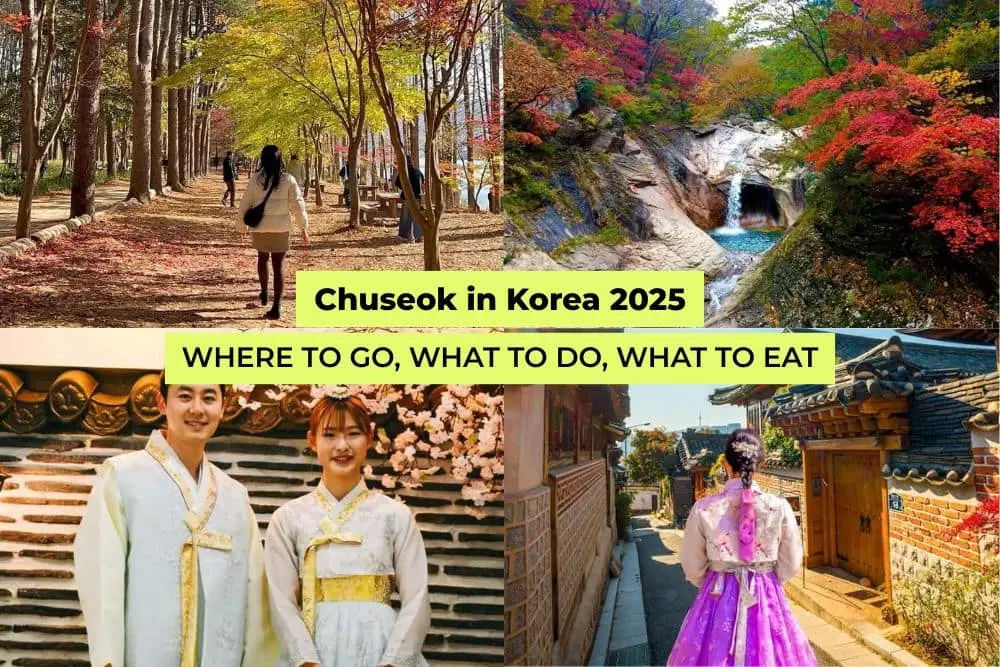
Chuseok in Korea is more than a holiday — it’s Korea’s Thanksgiving, marked by golden harvests, family feasts and the full moon.
Every autumn, Koreans honour their ancestors, share songpyeon rice cakes and spend time together in hanbok.
For travellers, being in Korea during the festivities is like stepping into a living tradition: palaces host cultural performances, folk villages come alive with games and music and the streets are festive and calm.
In this guide, you’ll find when the holiday is in 2025, why it matters and how to make the most of the celebrations as a visitor.
What is Chuseok?
Chuseok means great middle of autumn and is Korea’s mid-autumn festival and biggest traditional holiday. It’s often called Korea’s Thanksgiving Day and is as important as Lunar New Year in Korean culture.
Celebrated under the harvest moon, it dates back centuries — one legend links it to a 3rd-century Silla weaving contest, while others say it began as an ancient shamanistic ritual to thank the gods for a good harvest.
Families honour their ancestors through charye (ritual food offerings) and seongmyo (visiting and tidying graves), then gather to share seasonal dishes. Preparing a full table of freshly harvested food isn’t just about the meal. The dishes are also placed before ancestors during charye. This tradition ties gratitude for the harvest directly to family heritage.
When is Chuseok in 2025?
In 2025, Chuseok falls on Monday, 6 October, with the holiday running from 6–8 October. This is followed by Hangul Day on 9 October, giving many Koreans an extended break.
The date changes every year and is always on the 15th day of the 8th lunar month. Since dates follow the lunar calendar, Chuseok usually falls in late September or early October.
Expect busy trains, sold-out flights, and heavy traffic as millions travel to see family. But with a little planning, being in Korea during Chuseok is an experience you won’t forget.
What Do People Eat During Chuseok?
Photo: @genjosam
Tables are filled with classics like jeon (savoury pancakes), japchae (stir-fried glass noodles), galbijjim (braised short ribs), and bulgogi. Seasonal fruits such as pears, persimmons, apples, and grapes are also served, along with hangwa(traditional Korean sweets made from rice flour and honey) like yakgwa (honey cookies). Rice wine such as makgeolli or dongdongju rounds out the feast.
The star dish is songpyeon (half-moon rice cakes), filled with sesame seeds, red beans or chestnuts. Traditionally, families made them together, steaming the rice cakes over pine needles — the fragrance symbolises purity and prosperity.
Many restaurants serve special holiday menus and markets like Gwangjang are perfect for sampling seasonal ingredients and street snacks. Joining a walking tour also helps you navigate the maze of stalls and taste the best local favourites.
Is Korea Open During Chuseok? What Travellers Need to Know (2025)
One common worry for travellers is, “is everything closed during Chuseok?” The answer is no — major attractions and essential services are open.
By the second and third day, most shops and restaurants are back to business and even popular stores like Olive Young in Myeongdong usually keep their regular hours. It’s not uncommon to see tourists and locals strolling around Insadong and Bukchon.
Photo: @anastasia_black_dahlia on Instagram
However, there are still some things you can expect to be closed. Here’s a rundown of what to expect when visiting Korea during Chuseok.
Shops and restaurants: Many small eateries close on the main Chuseok day (6 Oct 2025), some for 2-3 days. Tourist districts usually have plenty open. Department stores often close only on Chuseok day, while convenience stores and chain cafes stay open. By day three, most of Seoul feels normal again.
Tourist attractions: Palaces, museums and parks are open, some with free entry or special events. Nami Island ferries run on a holiday schedule (usually every 30 minutes from 7:30am to 9:00pm). Coex Mall and Gwangjang Market may close on the main day but reopen quickly. Hongdae is quiet in the morning but lively in the evening.
Theme parks: Everland and Lotte World are open throughout Chuseok. Visiting on the main day means lighter crowds with extra folk games and performances.
Transportation: Expect heavy traffic before and after the holiday (3-4 Oct for departures, 8 Oct for returns). Book trains and buses in advance. Within cities, public transport runs on a holiday schedule but covers all routes. The KORAIL Pass is especially useful for intercity travel — for example, Seoul to Busan takes about 2.5 hours on the KTX, while Seoul to Daegu takes 1.5 hours — making it an easy and efficient way to get around during the break.
Pro tip: KTX tickets open for booking one month in advance and sell out quickly during Chuseok
15 Best Places to Experience Chuseok in Korea (2025)
Spending Chuseok in Korea isn’t just about family rituals.
You might watch folk games in a hanok village, join locals in hanbok at royal palaces or wander coastal markets buzzing with holiday energy. From city festivals to island traditions, every region has its own way to mark the harvest moon.
Here are some of the best places to celebrate Chuseok in South Korea this 2025.
Celebrating in Seoul
1. Bukchon Hanok Village
Spending Chuseok in Seoul? Then a walk through Bukchon Hanok Village is one of the most atmospheric ways to experience the holiday.
Located between Gyeongbokgung and Changdeokgung, this neighbourhood comes alive with hanbok-clad visitors, folk performances and seasonal displays.
The narrow lanes and tiled-roof houses feel like stepping back in time, with photo-ready courtyards, tea houses and cultural events in a festive yet peaceful setting.
How to get there: Anguk Station (Line 3, Exit 2) is the most direct. From there, it’s a 10-minute walk into the village.
Tips: Be respectful, as many hanok are private homes.
2. Gyeongbokgung Palace
If you want to see Chuseok traditions in full swing, head to Gyeongbokgung Palace — the heart of Seoul’s royal heritage.
The palace comes alive with cultural performances, music, dance and folk games, while visitors fill the courtyards.
It’s one of the most memorable places to celebrate the holiday. Entrance is KRW 3,000 (USD 2), but free if you wear hanbok.
How to get there: Gyeongbokgung Station (Line 3, Exit 5) is the most direct. Alternatively, take Gwanghwamun Station (Line 5, Exit 2) for a short walk.
Tips: Arrive early to catch the royal guard changing ceremony at the main gate.
3. Changdeokgung Palace
For a more peaceful Chuseok experience, head to Changdeokgung Palace, famous for its Secret Garden and beautiful landscapes.
The Secret Garden is especially lovely under the harvest moon, and renting a hanbok nearby not only completes the festive experience but also gives you free entry into the palace. While it usually costs KRW 3,000 (USD 2) to enter the palace, it is free if you wear a hanbok.
How to get there: Take Anguk Station (Line 3, Exit 3). It’s about a 5-10 minute walk to the main entrance.
Tips: Visit in the morning for softer light and quieter grounds, or late afternoon to catch the golden glow before moonrise.
4. Lotte World
For fun in the heart of Seoul, grab tickets to Lotte World. Tickets cost KRW 59,000 (USD 45) for adults.
This massive theme park — indoor and outdoor — is open throughout Chuseok.
The indoor Adventure section has parades, performances and seasonal displays, while Magic Island outside has roller coasters with the Seoul skyline as backdrop.
How to get there: Jamsil Station (Line 2 or Line 8, Exit 4). The park is connected to the subway.
Tips: Visit on Chuseok day for smaller crowds. Stay for the evening parade and fireworks.
5. N Seoul Tower
For sweeping city views under the glowing sky, N Seoul Tower is a must-visit.
Perched on Namsan Mountain, it’s open during Chuseok and sometimes has cultural shows or light displays. Tickets are priced at KRW 21,000 (USD 16).
Families, couples and solo travellers gather here to soak up the festive atmosphere, take photos and dine with a view.
How to get there: Myeongdong Station (Line 4, Exit 3) and walk 15 minutes uphill to the Namsan cable car. Or take the Namsan Sunhwan Shuttle Bus (Routes 02, 03, or 05) to the tower.
Tips: On Chuseok day, it’s festive but relaxed, with shorter lines than usual.
6. Namsangol Hanok Village
Namsangol Hanok Village in central Seoul is the place to go to see traditional performances up close.
For Chuseok, it’s filled with folk games, craft workshops and performances like ganggangsullae (a moonlit circle dance that's one of Korea's most iconic folk traditions) and tightrope walking.
It’s one of the best places to see how families used to celebrate the harvest — all in a casual outdoor setting. You can combine this with stops to N Seoul Tower, National Gugak Museum, and Myeongdong Night Market.
How to get there: Chungmuro Station (Line 3 or Line 4, Exit 4) and walk 5 minutes to the entrance.
Tips: Visit on the holiday itself to enjoy hands-on activities and performances.
Celebrating in the Greater Seoul Area
7. Everland
If you’d rather enjoy festive fun than tradition, head to Everland — Korea’s largest amusement park.
Everland is open throughout Chuseok, with lighter crowds as many locals are with family or visiting their hometowns.
It’s the perfect time to enjoy rides without long queues, plus seasonal parades, folk games and harvest-themed decorations. Tickets cost KRW 62,000 (USD 47) for adults.
How to get there: Everline subway to Jeondae–Everland Station, then shuttle bus to the entrance. From central Seoul, about 1.5 hours by public transport.
Tips: Go on Chuseok day for shorter lines. Arrive early to make the most of the rides, and stay for the evening parade and fireworks.
8. Seoul Land
Looking for a family-friendly alternative to the big theme parks? Then Seoul Land is a fun option.
Located inside Seoul Grand Park, it’s smaller than Everland or Lotte World but still has rides, seasonal flowers and themed events. Tickets cost KRW 36,000 (USD 27) for adults.
Seoul Land has folk games and cultural performances alongside its usual attractions during Chuseok, so you get tradition and thrills in one visit.
How to get there: Seoul Grand Park Station (Line 4, Exit 2). Short walk or shuttle to the entrance.
Tips: Arrive early to enjoy the rides before it gets busy, and leave time to visit the zoo or botanical garden inside Seoul Grand Park.
9. Nami Island & Garden of Morning Calm
Photo: @wanderwithgaby on Instagram
For an escape from the city, Nami Island and the Garden of Morning Calm are unbeatable.
Both are open during the holiday, so perfect for day trips when some Seoul shops are closed. Nami Island is loved for its tree-lined paths, riverside walks and autumn foliage, while the Garden of Morning Calm glows with seasonal flowers and moonlit displays.
Together they offer nature, beauty and a festive atmosphere far from the city. But do take note, both places have separate fees. Nami Island's admission is KRW 16,000 (USD 12) including the ferry ride. Meanwhile, Garden of Morning Calm's admission is KRW 10,000 (USD 7).
How to get there: ITX train from Yongsan or Cheongnyangni Station to Gapyeong Station (about 1 hour). From there, take the Gapyeong Shuttle Bus which stops at both Nami Island and the Garden of Morning Calm.
Tips: Wear comfortable shoes and bring a light jacket as fall evenings can get chilly
10. Suwon Hwaseong Fortress
For a mix of history and celebration, Suwon Hwaseong Fortress should be added to your itinerary.
This UNESCO World Heritage site, built in the late 18th century, comes alive during Chuseok with martial arts displays, folk games and cultural performances.
Walk the fortress walls for city views, explore pavilions and archery ranges and stay for the evening to see the walls glow beautifully under soft night lighting.
How to get there: From Seoul, take Line 1 to Suwon Station, then local bus or taxi (about 15 minutes) to the fortress. Some Pelago tours include transport and guided experiences.
Tips: Visit in the afternoon to catch cultural performances often scheduled around Chuseok.
11. Korean Folk Village
For a hands-on cultural experience during the festive season, the Korean Folk Village near Yongin is hard to beat. Tickets are around KRW 22,000 (USD 16) for adults.
This open-air museum recreates life from the Joseon era with traditional houses, workshops and live performances. Once it's Chuseok day, it gets even more lively with folk games, dance shows and ritual re-enactments.
You can combine a trip here with a visit to nearby Suwon Hwaseong Fortress for a full day of history and culture.
How to get there: From Seoul, take the subway to Suwon Station (Line 1) and transfer to Bus 37, 10-5 or 66 which stops at the Folk Village. Travel time is about 1.5 hours from central Seoul.
Tips: If you’re visiting on Chuseok day itself, stay into the evening — lanterns and traditional lighting make the village especially atmospheric at night.
Celebrating Outside of Seoul
12. Jeju Folk Village
Photo: @102ksh on Instagram
If you’re celebrating Chuseok on Jeju Island, the Jeju Folk Village should be included in your trip. Tickets are KRW 11,000 (USD 8) for adults.
This open-air museum has over 100 restored thatched houses showing daily life on Jeju in the late Joseon period.
During the festive season, it comes alive with folk games, performances and seasonal displays, offering a glimpse of how islanders used to honour the harvest.
How to get there: From Jeju City, take Bus 720 or 721 towards Pyoseon and get off at Jeju Folk Village. The trip takes about 1 hour by bus or 40 minutes by car.
Tips: Combine with a visit to a nearby mandarin farm, where you can try fruit-picking — a fun seasonal activity tied to Jeju’s autumn harvest.
13. Seoraksan Mountain
Looking to soak in the festivities surrounded by nature? Check out Seoraksan Mountain, one of Korea’s most beautiful escapes.
During the holiday, its peaks glow with the first signs of autumn and many locals hike here to combine gratitude with nature’s beauty. Peak admission is KRW 3,500 (USD 3) for adults.
Trails range from easy strolls to tough climbs, and a cable car makes summit views accessible.
How to get there: From Seoul, take an express bus to Sokcho (about 2.5 hours), then transfer to a local bus or taxi for the short ride to Seoraksan National Park.
Tips: If visiting on Chuseok day, pack a picnic with seasonal snacks like songpyeon and enjoy at one of the rest spots.
14. Andong Hahoe Folk Village
For a deep dive into tradition, Andong Hahoe Folk Village is the place to be.
This UNESCO World Heritage site preserves a centuries-old clan village of tiled-roof houses, straw huts, and scenic riverside views.
During Chuseok, it comes alive with cultural performances — from the famous Hahoe mask dance to folk games and ritual displays.
How to get there: From Seoul, take a KTX train to Andong (about 2 hours), then transfer to a local bus or taxi (about 20–30 minutes) to the village.
Tips: Arrive early to enjoy the village before tour groups arrive. Stay for the Hahoe mask dance performance, which is especially popular during Chuseok.
15. Bulguksa Temple
Eyeing a spiritual and festive experience? Then Bulguksa Temple in Gyeongju is a must-visit.
This UNESCO World Heritage site is Korea’s most famous Buddhist temple, known for its stone pagodas, serene courtyards, and intricate wooden halls.
During the season, the temple feels especially meaningful, with visitors coming to reflect, light lanterns, and take in the scenery. It’s also one of the best places to experience autumn in Korea, with vibrant colours adding to the temple’s tranquil atmosphere.
How to get there: From Gyeongju Station, take Bus 10 or 11 (about 40 minutes) to Bulguksa Temple.
Tips: Combine your visit with nearby Seokguram Grotto and Daereungwon Tomb Complex. Together, they make a perfect Chuseok day trip blending history, spirituality, and heritage.
Chuseok Traditions: Rituals, Games, and Festivities
One of the highlights of Chuseok is the balance of solemn rituals and festive fun.
Ancestral rites (Charye): Families set up a table of food and bow to their ancestors. Museums often display Chuseok tables for visitors as it’s rare for foreigners to witness charye unless invited to a local’s home.
Grave visits (Seongmyo): Families visit ancestral graves to tidy and pay respects, highlighting the holiday’s family focus.
Folk games: From juldarigi (tug-of-war) and ganggangsullae to board games like yutnori and card games like hwatu.
Hanbok: Still a symbol of Chuseok, especially at palaces and cultural events. Visitors can rent one for the holiday vibe and free palace entry.
Crafts: Holiday festivals often feature mask-making, hanji (paper) art or DIY songpyeon rice cakes.
Gift-giving: Modern Chuseok gift sets are a huge part of the holiday. Alongside premium fruit boxes, ginseng, and the iconic Spam sets, you’ll also find luxury cooking oils, health tonics, teas, beauty and skincare gift packs, and even high-end coffee or wine hampers. Department stores are filled with beautifully packaged options in the weeks before Chuseok, making gifting as much a part of the season as food or rituals.
Tip: To greet someone a "Happy Chuseok," you can say "추석 잘 보내세요 (Chuseok jal bonaeseyo)."
Are You Ready To Celebrate Chuseok in South Korea?
From ancestral rituals to festive markets, Chuseok in Korea is a holiday where tradition, family and celebration come together.
Whether you’re trying fresh songpyeon, watching folk dances in hanok villages or catching fireworks at a theme park, it’s one of the best times to experience Korea at its cultural best. So mark your calendar, put on a hanbok and get ready to celebrate Korean Thanksgiving under the harvest moon.